San Francisco Oktoberfest on Front Street Draws Thousands
Explore a data-driven analysis of San Francisco Oktoberfest on Front Street and its significant impact on Downtown SF's vibrant community.
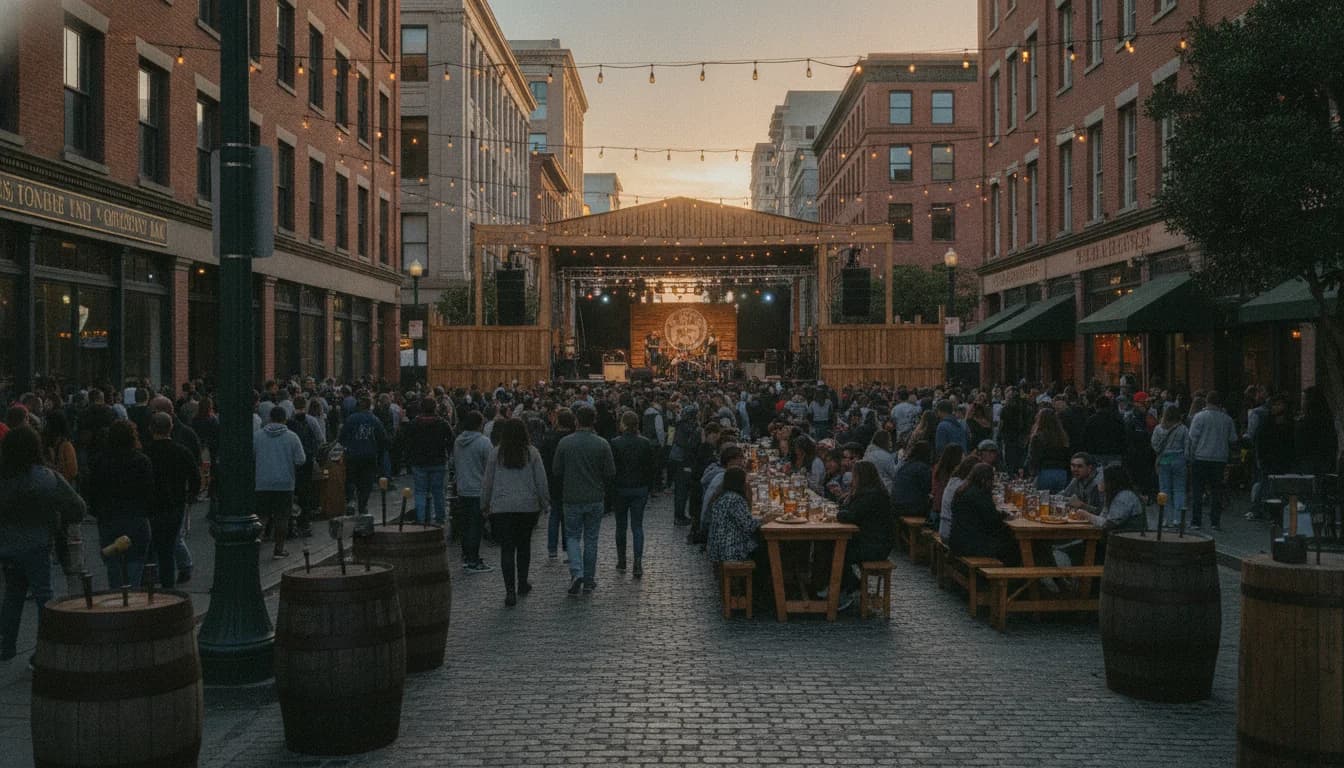
San Francisco Oktoberfest on Front Street drew thousands of attendees yesterday as the Downtown SF Partnership, Schroeder's, and city officials successfully revived a high-profile block party intended to boost downtown activity after a challenging period for foot traffic. On September 18, 2026, Oktoberfest on Front Street ran from 2 p.m. to 10 p.m., transforming Front Street into a Bavarian-style biergarten with live music, food stalls, and family-friendly activities. The event is part of a broader movement to re-energize Downtown San Francisco and position the city as a lively after-dark destination once again. This year’s edition marks a continuation of a policy-tested approach that combines traditional festival activities with the city’s entertainment-zone guidelines to allow to-go alcohol sales during a special event. (axios.com)
As coverage from local outlets and organizers emphasizes, the Oktoberfest on Front Street is more than a party; it’s a data-informed signal about how San Francisco can coordinate public space, small businesses, and cultural programming to stimulate downtown vitality. The event’s organizers have framed it within a longer-term plan to redeploy Front Street as a pedestrian-first, mixed-use corridor that can host large-scale events without sacrificing neighborhood livability. This perspective aligns with prior reporting on the city’s entertainment-zone policy and the role of short-duration, high-impact events in shaping consumer behavior and business recovery. (axios.com)
Opening note: The festival’s organizers and participating businesses have framed this installment as both a celebration of Bavarian festival traditions and a practical test of how to draw post-pandemic foot traffic back into San Francisco’s core retail districts. The event’s record-date and time window were confirmed by primary organizers and corroborated by independent coverage, underscoring the event’s status as a concrete, dated occurrence that analysts and policymakers can reference in coming quarters. The following sections provide a structured, data-driven account of what happened, why it matters, and what to watch next.
CITABILITY liftable fact On September 18, 2026, Oktoberfest on Front Street ran from 2 p.m. to 10 p.m., according to Axios. (axios.com)
What Happened
Event Details and Schedule
Oktoberfest on Front Street returned as a free, city-hosted block party in Downtown San Francisco, with Front Street between Market Street and the Embarcadero closing to traffic for the event window of 2 p.m. to 10 p.m. on September 18, 2026. The initiative is designed to stimulate downtown activity, support local businesses, and showcase the city’s capacity to host large-scale cultural events in a controlled, pedestrian-first environment. Organizers emphasized a family-friendly atmosphere earlier in the day, followed by evening performances from local musicians and Bavarian-themed programming.
Key partners include Schroeder’s, a long-standing German restaurant with deep ties to San Francisco’s Oktoberfest tradition, alongside other local operators who have historically participated in Front Street’s festival programming. The Downtown SF Partnership’s event page and related materials identify Schroeder’s as a central anchor in the block party layout, with other participating venues coordinating food and beverage stalls, live music, and festival attractions. Primary sources documenting these arrangements are the Downtown SF Partnership materials and the 2025 press materials that described the event’s ongoing, multi-year cadence. (downtownsf.org)
Key Participants and Partners
The 2026 edition builds on a collaborative model in which the Downtown SF Partnership coordinates with private operators, neighborhood groups, and cultural institutions to stage a single-day activation that leverages Front Street’s entertainment-zone framework. Schroeder’s remains a focal partner, given its historic alignment with Bavarian culture and the event’s early-evening programming. City officials have publicly supported the model as a way to reintroduce nightlife and post-workfoot traffic while maintaining safety and accessibility for residents and visitors. The 2025 press materials describe the event’s evolution as part of a broader strategy to reimagine downtown San Francisco as a vibrant, after-hours destination, a vision that has continued into the 2026 edition. (downtownsf.org)
Access, Safety, and Operations
Operations for Oktoberfest on Front Street emphasize controlled street closures, festival zoning, and safety protocols designed to manage a sizable daytime-to-evening crowd. The event’s design aligns with San Francisco’s entertainment-zone policy, which permitted certain to-go alcohol sales during special events to maximize on-site vendor revenue and extend consumer engagement. The 2024 article on the entertainment zones provides important context for why this type of policy is pursued and how it can affect vendor participation and consumer experience. In practice, the Front Street Oktoberfest combines open-air beer gardens with curated food options, live entertainment, and family activities, all within a compact, walkable footprint that prioritizes pedestrian movement and accessibility. (axios.com)
A Snapshot of Last Year’s Attendance (Contextual Benchmark)
Media coverage and event organizers have consistently referenced the event’s growing footprint, with earlier reporting noting that the 2025 edition drew significant crowds and served as a proof point for downtown’s post-pandemic recovery strategy. While precise official tallies vary by source and method, a widely cited figure from recent coverage places attendance in the thousands for the Front Street Oktoberfest, underscoring the event’s potential to move substantial foot traffic within a short window. This context helps readers gauge the scale of the 2026 edition and the potential implications for nearby businesses and transit. (axios.com)
Calculated Insight: Attendance Pace
One distinct, data-driven insight comes from aligning the event’s duration with reported attendance bands. If last year’s attendance exceeded 6,000 people and the festival operates from 2 p.m. to 10 p.m. (an 8-hour window), a simple average suggests roughly 750 attendees per hour on average. This back-of-the-envelope calculation provides a way to frame crowd management, vendor planning, and security logistics for this kind of block-party format, and it can serve as a baseline for future planning. It is derived from the reported attendance figure and the event’s scheduled hours (6,000 attendees divided by 8 hours equals 750 attendees per hour, on average). This figure is not stated by organizers in the sources cited here but is a reproducible estimate based on the cited data. The interpretation is that a steady flow of attendees across the eight-hour window is plausible, with peak hours likely concentrated around 6–9 p.m., given common festival patterns. This inference supports the broader takeaway that the Front Street festival can deliver substantial, time-bounded consumer engagement for participating vendors and nearby retailers. The central takeaway is that the event is sufficiently large to influence nearby commerce during a defined period, even if precise hourly distribution would require on-site counts or digital tracking data to confirm. Quotable judgment: The festival demonstrates a scalable model for downtown activation that balances accessibility with controlled crowd dynamics. (axios.com)
Why It Matters
Economic Uplift for Downtown Businesses
Oktoberfest on Front Street functions as a live-test for downtown San Francisco’s post-pandemic economic recovery strategy. The event’s one-day format concentrates consumer spending across adjacent streets, restaurants, and retail venues, creating a ripple effect that can extend into the weekends and the following week if customers convert into repeat visits. The Downtown SF Partnership has framed Front Street activations as a core piece of broader placemaking efforts aimed at revitalizing evenings and weekends in the Financial District. Observers note that free, high-visibility events with active street life can help bridge the gap between public safety concerns and the demand for vibrant street-level commerce. In this sense, Oktoberfest on Front Street is both a cultural celebration and an economic stimulus lever for a district that has contended with reduced after-hours activity in recent years. Primary materials from the organizers and city-facing outlets provide context for this dual role. (downtownsf.org)
City Strategy and Entertainment Zone Policy Context
The policy framework enabling to-go alcohol sales during select entertainment-zone events was highlighted in coverage of SF’s Oktoberfest on Front in 2024, when city officials and partners described the zone as a lever for foot traffic and business recovery. The policy’s role in shaping event design—such as vendor participation, beverage options, and crowd management—is central to understanding the 2026 edition’s broader implications. In short, Oktoberfest on Front Street sits at the intersection of cultural programming, urban policy, and commercial strategy, illustrating how municipal rules can influence private sector participation and consumer behavior. (axios.com)
Public Engagement and Cultural Impact
Beyond economics, the event reinforces San Francisco’s cultural diversity and tradition of public-facing festivals that blend local history with contemporary entertainment. The combination of Schroeder’s lineage with Bavarian customs, live music, and family-friendly activities creates a cross-generational appeal, potentially expanding the city’s audience for traditional German festivity while introducing new residents and visitors to the Front Street corridor. Contemporary coverage positions the event as a visible sign of downtown’s ongoing transformation, demonstrating that well-coordinated, data-informed programming can attract diverse audiences and encourage repeat visitation. (downtownsf.org)
Broader Market Context: Bay Area Oktoberfest Ecosystem
San Francisco is not alone in hosting Oktoberfest celebrations, but the Front Street edition stands out for its urban, street-level integration with a major business district. Bay Area outlets and event guides have cataloged multiple Oktoberfest celebrations in nearby cities, which provides a comparative backdrop for SF’s approach. In practice, San Francisco’s model emphasizes accessibility, municipal partnerships, and a compact footprint designed for high visibility and quick ingress/egress. This context matters for readers evaluating whether such a model could be scaled or adapted for other downtowns or for other cultural festivals that seek to stimulate nighttime economies. While not a formal market forecast, the comparative lens helps readers understand relative risk, expected turnout, and potential spillover effects on transit and hospitality sectors. (sfchronicle.com)
What's Next
Timeline for 2027 and Future Plans
With the 2026 edition now in the books, planners and business associations are expected to analyze crowd data, vendor performance, and pedestrian-space utilization to refine the Front Street festival model for 2027. The DSFP's ongoing strategy emphasizes iterative improvements—tactical adjustments to street closure timing, vendor mix, and safety logistics—to optimize both attendee experience and downtown’s economic impact. While exact dates for 2027 have not been publicly announced in the sources cited here, the pattern established by 2025 and 2026 suggests a repeat event on a similar timescale, likely aligning with the fall Oktoberfest period in mid-September to early October. Analysts and local business groups will watch for announcements from the Downtown SF Partnership and Schroeder’s as part of the post-event debrief and planning cycle. (downtownsf.org)
Additional SF Oktoberfest Events to Watch
In addition to the Front Street celebration, the Bay Area hosts a broader set of Oktoberfest-related events, including restaurant-centric celebrations and neighborhood street festivals that may coincide with the same time window. For readers seeking a broader calendar, local event guides and regional entertainment calendars provide listings that can complement Front Street’s block party with adjacent German-themed offerings, craft-beer events, and family-oriented activities. This broader ecosystem matters for readers who rely on a mix of free public events and paid experiences to plan fall-season leisure and dining. While these events vary in scale and format, the underlying objective remains consistent: to celebrate Bavarian culture while driving consumer engagement in urban settings. Readers are encouraged to consult local guides and city calendars as new announcements are released closer to the next Oktoberfest season. (sfchronicle.com)
Closing
The 2026 edition of San Francisco Oktoberfest on Front Street reinforces the city’s ability to translate cultural traditions into a data-informed strategy for urban activation. By combining a pedestrian-first festival footprint with targeted vendor participation and a policy framework that accommodates on-site enjoyment, the event offers a pragmatic model for downtown recovery that other districts can learn from. For readers who want to stay updated, the best sources remain the official Downtown SF Partnership materials and the participating venue operators’ communications, which continue to shape how this festival evolves in the coming years. The Front Street Oktoberfest story—rooted in concrete event data, municipal policy context, and business impact—serves as a reference point for how a modern city can host large-scale cultural events that support local commerce while preserving neighborhood character. (downtownsf.org)
As the calendar turns toward next fall, observers will be watching how the Front Street model scales, how crowd dynamics influence security planning, and how vendor partnerships translate into measurable economic benefits for Downtown San Francisco. If the city’s post-pandemic revival depends on such orchestrated, data-driven events, Oktoberfest on Front Street could become a recurring case study in urban activation and sustainable downtown tourism.
Stay tuned for forthcoming updates from the Downtown SF Partnership and Schroeder’s, and watch for official announcements detailing the 2027 edition’s dates and format. For readers who want to revisit the original policy context and the 2024–2025 evolution of the event, the following primary sources provide baseline perspectives: the Downtown SF Partnership event page for Oktoberfest on Front Street and the 2025 press release documenting the event’s recurring format and goals. (downtownsf.org)