Airport Perimeter Dike Improvement Project Near Completion

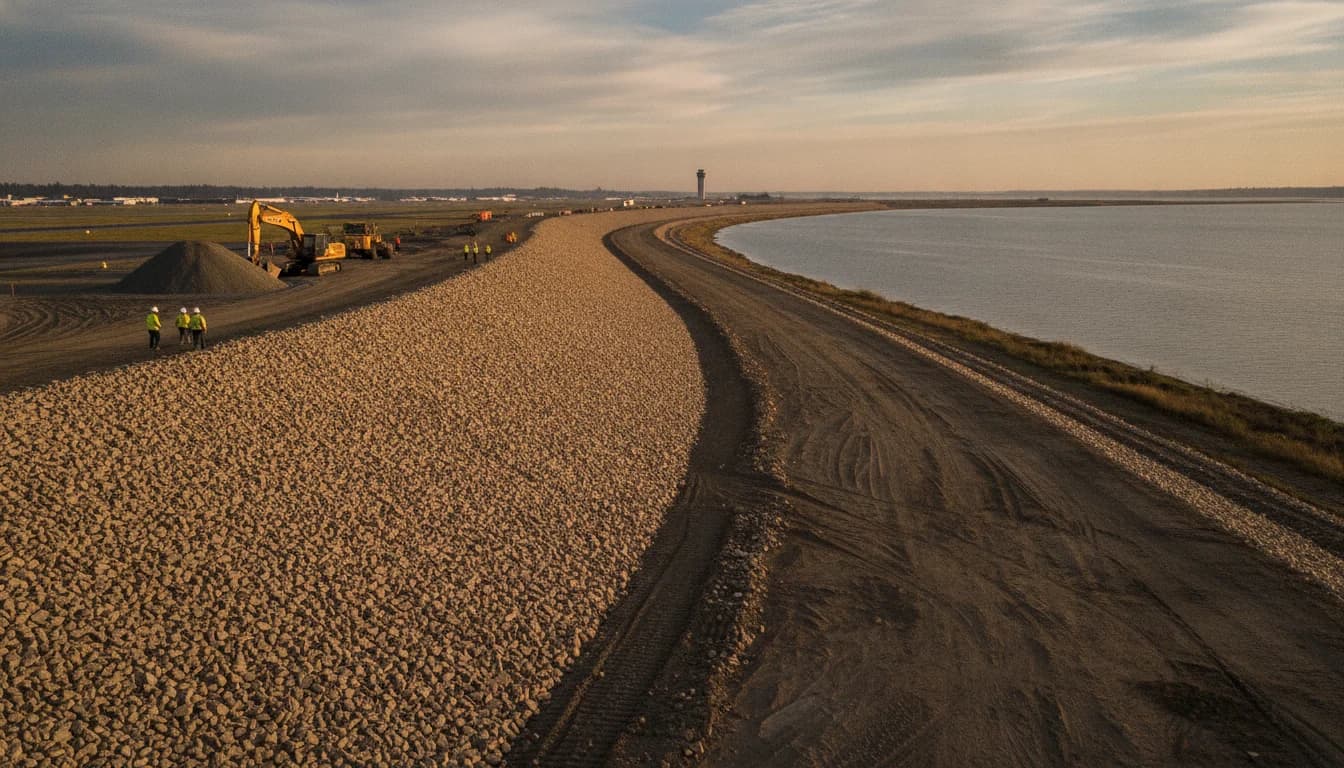
The Port of Oakland and Oakland International Airport (OAK) announced in mid-June 2026 that the Airport Perimeter Dike Improvement Project near completion (Port of Oakland) is on track to finish this September. This major infrastructure effort, running along the airport’s shoreline and designed to shield the airfield from tidal flooding and rising seas, marks a milestone in Bay Area resilience efforts. The news arrives as climate and seismic risks continue to shape the region’s infrastructure priorities, and readers will want to understand what has been accomplished, why it matters for aviation and the broader economy, and what comes next as authorities push to wrap up this multi-phase effort. The project, with a total price tag around $80 million, is a two-phase program aimed at strengthening flood protection and seismic resilience for Oakland’s primary airfield, which sits on low-lying reclaimed bay land and serves as a critical regional hub. “As we build for future generations, the Airport Perimeter Dike Project reflects our commitment to resilient infrastructure, environmental stewardship, and economic vitality,” said Kristi McKenney, Executive Director at the Port of Oakland, underscoring the broader mission beyond simply protecting runways. (portofoakland.com)
The Airport Perimeter Dike Improvement Project near completion (Port of Oakland) is not just a local upgrade; it is positioned as a cornerstone of Bay Area coastal resilience. The dike in question runs roughly 4.5 miles along the airport’s southern and western waterfront between Alameda and San Leandro, protecting essential airfield operations from flooding, wave action, and tidal surges. This long, sand- and clay-based structure has stood since the 1950s and has undergone targeted upgrades roughly every few decades to maintain stability in the face of changing climate and increased seismic risk. The current program builds on a legacy of prior improvements and uses modern design approaches to extend the life of the runway and maintain critical aviation capacity in the East Bay. (portofoakland.com)
The project’s two-phase design has clearly delineated milestones. Phase 1, completed in 2022, raised the dike height to FEMA-adopted levels and exceeded them by about a foot to provide added protection against storm surge and sea‑level rise for the next 30–35 years. The Phase 1 package totaled about $30 million, supported in part by California Local Levee Assistance Program grants totaling $6.4 million, with the remainder funded by the Port of Oakland. Phase 2 focuses on seismic resiliency, applying Cement Deep Soil Mixing to stabilize the ground beneath the dike and reduce the risk of liquefaction during earthquakes. The phase covers a targeted 5,000-foot section along a key portion of the south field near Runway 12-30 and is projected to complete in September 2026. The combined Phase 1 and Phase 2 costs total roughly $80 million. (portofoakland.com)
Section 1: What Happened
Phase 1 Milestones: Rising Heights and Regulatory Alignment
- Began in early 2020 and reached completion in 2022, delivering a substantial uplift in flood protection for Oakland International Airport. The work raised the dike height to exceed FEMA standards and added an additional foot of elevation beyond those requirements, creating a longer horizon of protection against sea level rise, storm surge, and climate variability. The project’s Phase 1 footprint encompasses the approximately 4.5-mile perimeter that historically guards the airfield. The Phase 1 completion marked a critical first step in a two-phase approach designed to safeguard air operations for decades to come. The Phase 1 milestone and its funding sources were highlighted in 2022, with the Port noting the duration of roughly two years for Phase 1 and the project’s overall resilience objectives. (portofoakland.com)
Phase 2 Progress: Seismic Strengthening and Ground Stabilization
- Phase 2 represents the seismic-focused extension of the perimeter dike program. Based on risk analyses, a 5,000-foot segment of the dike is undergoing reinforcement using Cement Deep Soil Mixing (CDSM), an engineering technique that creates reinforced columns beneath the structure to mitigate settlement and liquefaction during earthquakes. Work on Phase 2 has progressed along the south field near Runway 12-30 and is described as the final segment of the two-phase effort. The phase is expected to wrap up in September 2026, consistent with the project’s overall near-completion timeline. The Phase 2 scope is supported by funding from the Federal Aviation Administration through the Airport Improvement Program, with the total Phase 2 cost estimated at about $52.7 million. (portofoakland.com)
Funding and Collaboration: Public Investment and Federal Support
- The project has leveraged a blend of public funding and Port investment. Phase 1 was a $30 million package, with approximately $6.4 million provided by California’s Local Levee Assistance Program. Phase 2, which focuses on seismic improvements and deep soil stabilization, carries an estimated cost of $52.7 million, with about $32 million funded by the FAA through the Airport Improvement Program. This funding mix reflects a broader pattern of federal and state support complementing port-led resilience investments to protect critical aviation infrastructure. The ongoing collaboration between the Port of Oakland, FAA, state programs, and local agencies underscores the project as a model for coordinated coastal infrastructure resilience. (portofoakland.com)
Phase 2: Status as of Mid‑June 2026
- As of June 2026, port officials described Phase 2 as “nearly complete” with the final work focused on a 5,000-foot segment along Runway 12-30 in the south field. The publication detailing the near-completion status also emphasized that the overall project aims to ensure airfield reliability in the face of climate and seismic threats, maintaining OAK’s operational capacity for the region’s economic activity and emergency responses. The press release framed the near completion as a milestone for resilience in the Bay Area and highlighted the significant role of CD Soil Mixing in strengthening the ground beneath the dike. (portofoakland.com)
Why It Matters
Coastal Resilience and Seismic Readiness: A Bay Area Priority
- The Airport Perimeter Dike Improvement Project near completion (Port of Oakland) is a visible example of how major public infrastructure is adapting to climate risk and seismic hazards. The phased approach—heightening the dike to FEMA standards and then fortifying the ground itself—addresses both tidal flooding and earthquake-induced deformation. The Port of Oakland has framed the project as a long-term investment in resilience for a critical regional asset, one that underpins safe air operations, cargo movement, and emergency response capabilities. The two-phase strategy is designed to yield protection for 30–35 years after Phase 1 and to extend that horizon further with Phase 2’s seismic enhancements. This approach reflects a broader regional emphasis on fortifying essential transportation and logistics assets against a changing climate and geologic risk profile. (portofoakland.com)
Operational Security and Regional Economy: Why OAK Matters
- The airport sits on low-lying reclaimed bay land and has long been a driver of employment, commerce, and connectivity in the East Bay and greater Bay Area. The Airport Perimeter Dike Improvement Project near completion (Port of Oakland) is positioned as essential infrastructure for maintaining continuous airport operations, especially during and after major weather events or earthquakes. In the Port’s framing, ensuring that OAK remains operational after significant events supports emergency response, cargo movement, and regional economic continuity. The project’s progress is thus not merely a civil engineering milestone; it is a strategic asset for resilience and economic stability in a region highly dependent on reliable air and ground transportation links. (portofoakland.com)
Environmental Stewardship and Community Context
- The Port of Oakland frames resilience efforts within a broader environmental stewardship and climate resilience program. The Airport Perimeter Dike Improvement Project near completion (Port of Oakland) aligns with the Port’s commitment to environmental stewardship, including flood protection, climate resilience, and sustainable infrastructure. The ongoing work integrates with the Port’s wider climate resilience and sustainability initiatives, reinforcing how utility-scale infrastructure projects can be designed to deliver protective benefits while supporting environmental and community goals. (portofoakland.com)
Economic and Funding Context: Public Investment in Resilience
- The project’s funding structure—combining state grants, federal support, and port investment—illustrates a widely used model for resilience projects that balance near-term capital costs with long-term risk reduction. Phase 1’s funding from California’s Local Levee Assistance Program and Phase 2’s FAA Airport Improvement Program support demonstrate how federal and state programs can complement port-led resilience efforts to protect critical infrastructure. This funding mix helps ensure that the project’s cost burden is shared among multiple stakeholders while delivering a high-value result: a fortified airfield with improved resilience to climate and seismic threats. (portofoakland.com)
What’s Next
Timeline to Completion: September 2026 Milestone
- With Phase 2’s near completion and a scheduled finish in September 2026, the Airport Perimeter Dike Improvement Project near completion (Port of Oakland) will mark the culmination of a multi-year effort to harden a critical piece of Bay Area infrastructure. Port officials have framed the September completion as the logical endpoint for the two-phase program, reflecting both engineering complexity and the logistical coordination required for heavy construction near active airfield operations. As completion approaches, readers can expect final testing, site restoration, and a transition plan for ongoing monitoring and maintenance. The project’s timeline remains tied to CD Soil Mixing work, final reinforcement activities, and coordination with FAA oversight to finalize documentation and ensure long-term compliance with safety and resilience standards. (portofoakland.com)
Next Steps: Monitoring, Maintenance, and Community Updates
- Following the completion of Phase 2, the Port of Oakland and OAK will likely advance a monitoring and maintenance regime to ensure the dike maintains its protective performance over time. This typically includes regular inspections, performance assessments under storm events, and coordination with environmental and permitting agencies to manage any emergent coastal or geological risks. Readers seeking updates can follow the Port of Oakland’s Media & Newsroom channel, which the Port uses to share press releases, progress reports, and milestone announcements. The near-term focus will be on post-construction validation, documentation, and ensuring that the airfield continues to operate safely under a changing climate and seismic landscape. (portofoakland.com)
Closing
In summary, the Airport Perimeter Dike Improvement Project near completion (Port of Oakland) stands as a landmark effort in Bay Area climate resilience and aviation readiness. Phase 1’s completion in 2022 established a robust baseline for flood protection, while Phase 2’s seismic reinforcement—using Cement Deep Soil Mixing—advances the airfield’s resilience to earthquakes. The project’s funding mix—state and federal support complemented by port investment—highlights how large-scale infrastructure resilience is financed in a way that spreads risk and accelerates protection for critical assets. As September 2026 approaches, stakeholders across the region will be watching not only for the formal completion but also for the practical benefits: fewer flood-related disruptions, greater operational certainty for OAK, and a more resilient backbone for the Bay Area’s transportation network. For ongoing updates, the Port of Oakland’s communications channels and the Port’s sustainability and climate resilience materials will provide the latest information on milestones, monitoring results, and future coastal resilience initiatives. The work completed so far underscores a broader commitment to protecting vital regional infrastructure while supporting economic vitality, environmental stewardship, and public safety for years to come. (portofoakland.com)