
Marina Safeway: 848 Homes SF Can't Afford to Block
Hundreds packed a Fort Mason town hall to fight 848 new homes at the Marina Safeway. San Francisco should approve them.
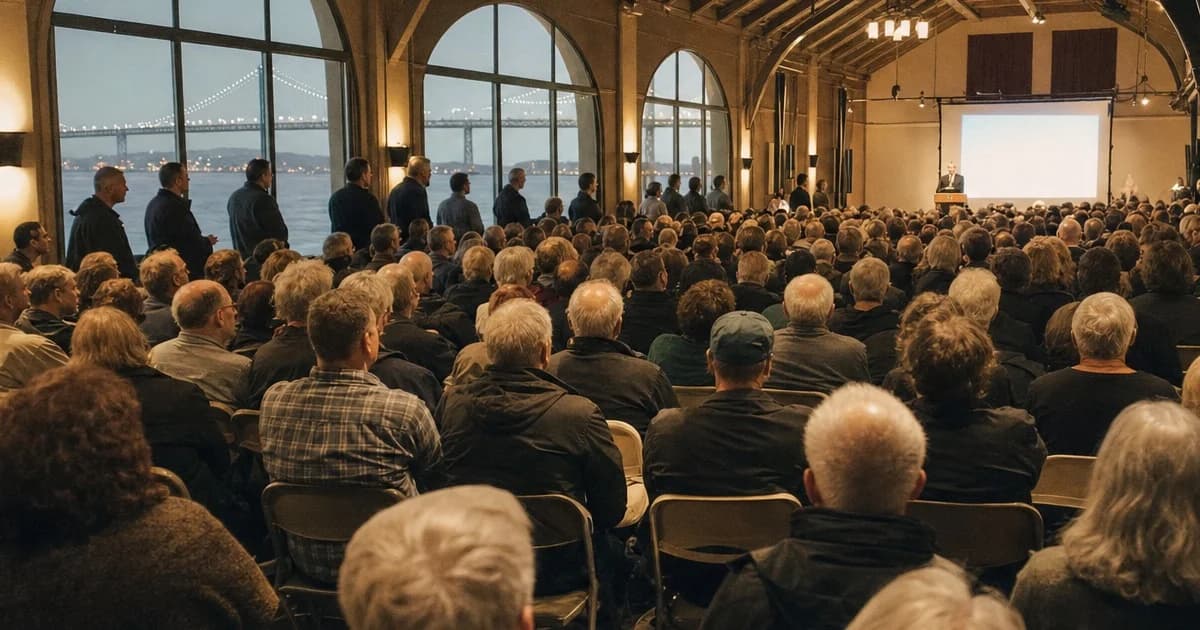
Several hundred Marina residents packed a hall at Fort Mason on the evening of Wednesday, July 23, for a town hall on the proposed redevelopment of the neighborhood's Safeway at Bay and Laguna streets. San Francisco Chronicle real estate reporter Laura Waxmann, who covered the meeting, posted from the room that hundreds had turned out over a project many in the low-slung waterfront neighborhood consider uncomfortably tall. Her post has since drawn more than 7 million views, which is a fair measure of how far past the Marina this fight has traveled.
The meeting was convened by District 2 Supervisor Stephen Sherrill and District 2 candidate Lori Brooke, both of whom oppose the project. The San Francisco Standard put attendance at roughly 250 and the crowd as mostly older residents. Marina Community Association vice president Erin Roach also spoke. The objections raised from the floor were infrastructure, parking, flooding and scale.
What is actually being proposed
Align Real Estate, filing on behalf of site owner Albertsons, submitted revised plans on July 16. The revision cuts the two towers from 25 and 22 stories to 22 and 18, roughly 258 and 219 feet, while raising the home count from 790 to 848. The affordable commitment stays at 86 below-market-rate units. The plan keeps a full replacement Safeway of about 67,000 square feet, adds a 349-car garage, and totals close to 990,000 square feet.
The unit mix is the part of the filing nobody argued about at Fort Mason, and it is the part that matters most. Of the 848 homes, 522 are studios or one-bedrooms, which is 62 percent of the building. That is not luxury inventory for people who already own in the Marina. That is the housing type a nurse, a graduate student, a line cook or a newly arrived engineer actually rents.
The project is moving under AB 2011, the state law that allows housing on commercial corridors to skip discretionary review and environmental study when it meets fixed objective standards and labor requirements. Opponents argue the site does not qualify because of its proximity to nearby parkland. That question will be settled by the Planning Department on the merits of the statute, not by the volume of a town hall.
The argument that was made, and the one that was not
"It's not about views," Brooke told the room, according to the Standard. "It's really about the fact that we have a weak infrastructure in the rain, and we notice it floods every time it rains."
Take that at face value. Marina drainage is genuinely bad, and the neighborhood sits on fill that liquefied in 1989. Those are real engineering constraints with real engineering answers, and they are priced into a project of this size through the permitting process. What they are not is a reason to keep a surface parking lot and a single-story supermarket on some of the most desirable transit-served land in the western United States.
The tell is what came next. Opponents are now backing a proposed statewide ballot measure, the Balanced Housing Act, that would amend California's constitution to bar the state from imposing housing growth mandates on cities that say their roads, sewers, parking and transit cannot take it. It would need roughly 875,000 signatures to qualify. An infrastructure complaint asks the developer to fix the storm drain. A constitutional amendment asks the state to make refusal permanent.
Our view
San Francisco has one economic engine and it has never been anything else: the city imports ambitious people and lets them build things. Immigrants founded a large share of the companies that pay for the parks, the buses and the fire department the Marina is worried about overloading. The engineers arriving on H-1Bs and the founders arriving on O-1s and the families arriving with no visa story at all are not a burden the infrastructure absorbs. They are the reason there is any infrastructure worth funding.
You cannot run that model and also refuse to build the rooms those people sleep in. A city that competes for global talent while capping its housing supply has not protected its character. It has simply chosen a slower, quieter, more respectable form of exclusion, one that shows up in the rent listings instead of in a policy anyone has to sign their name to.
That is the honest verdict on the Marina Safeway fight: the objection is not that 848 homes are too tall, it is that 848 households are too many, and San Francisco has spent forty years learning to say the second thing by saying the first. Twenty-two stories at Bay and Laguna will change the skyline of one neighborhood. Not building them changes who gets to live in the city at all.
Approve it. Make Align pay for the drainage work, hold the below-market units, and get the shovels in the ground. San Francisco should be a place people can still move to.