SF Pride Adds Extra Transit Service Across Bay Area
Muni, BART, SamTrans and regional agencies add service and reroutes for San Francisco Pride weekend.
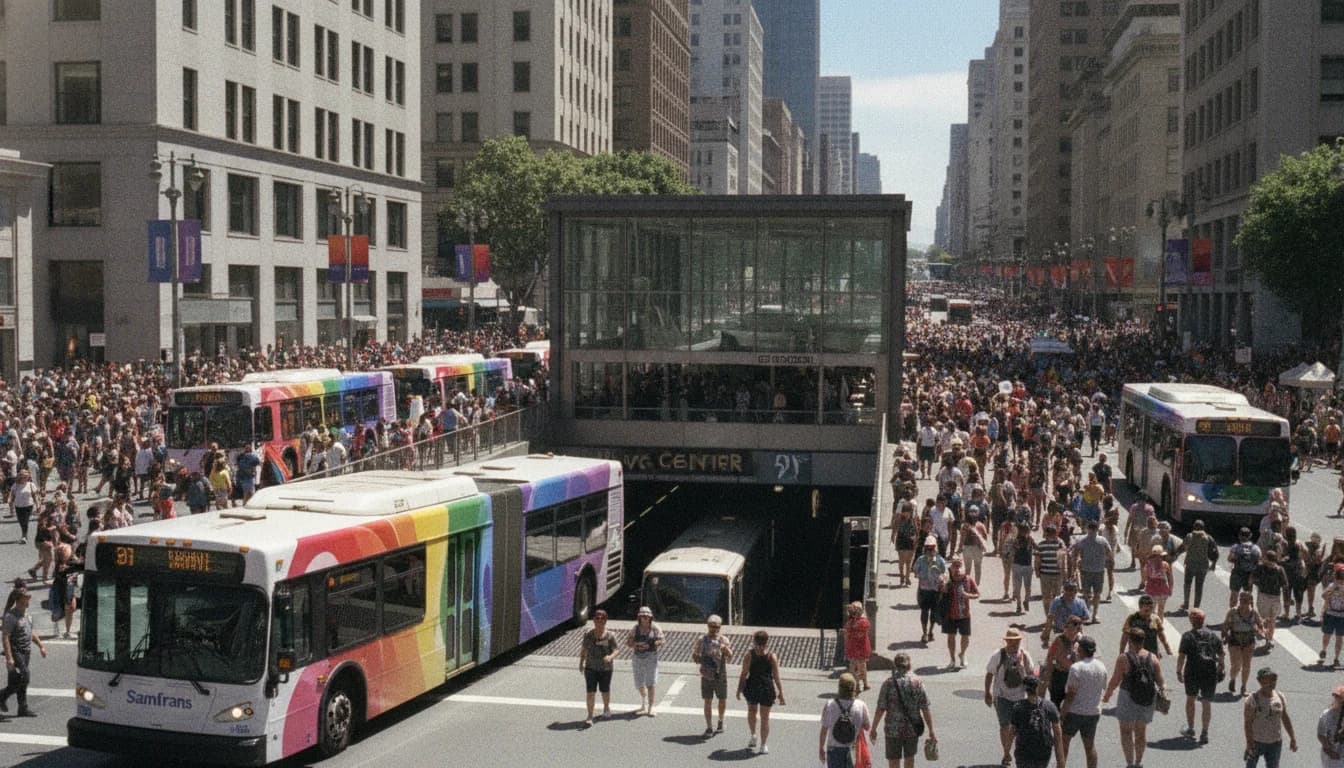
The 56th annual San Francisco Pride Parade is set to unfold on Sunday, June 28, 2026, with Bay Area transit agencies coordinating a citywide and regional response to move crowds efficiently and safely. San Francisco’s transit backbone will be amplified by a multi-agency effort designed to handle the surge in riders expected for Pride Weekend, including Muni, BART, SamTrans, and regional services. The news comes as agencies prepare for a weekend of events that began earlier in the week, including Trans March and the Trans Ally March, and culminates with the Pride Parade along Market Street. The approach combines early-morning rail injections, festival-related reroutes, and late-evening service adjustments to accommodate both attendees and workers who rely on transit to reach Civic Center and downtown neighborhoods. This coordinated effort matters not only for festival logistics but also for the broader Bay Area transit strategy as agencies coordinate across jurisdictions to support large-scale events. (bart.gov)
The coordinated pull-through of Pride transportation reflects a growing trend in transit planning: cross-agency collaboration aimed at maintaining reliability during high-demand events. In the weeks leading up to Pride Weekend, Bay Area agencies emphasized that the initiative is intended to connect riders from across nine counties to the parade route with consistent messaging, safety protocols, and real-time updates. SamTrans framed the effort as a first-of-its-kind regional collaboration for SF Pride Parade, illustrating how agencies from across the region are joining forces to ensure riders can reach the event and return home with predictable options. The result is a unified transit perspective that links specialized Pride services with regular schedules, fare integration, and rider assistance across multiple platforms. (samtrans.com)
Section 1: What Happened
Unified Bay Area Pride Transit Campaign
In the lead-up to Pride Weekend, Bay Area transit agencies announced a regional collaboration to support the SF Pride Parade on Sunday, June 28, 2026. SamTrans highlighted its participation in a broad Bay Area effort, featuring a Pride-themed bus and cross-agency coordination to connect riders to the parade route from across the nine-county region. The regional approach underscores a continuum of transit access—no single agency can meet Pride-related demand alone, so agencies are aligning schedules, riders’ information channels, and transfer policies to ease cross-system travel. This collaboration is designed to ensure that riders can reach Civic Center and Market Street with minimal friction, whether they originate in San Mateo County, the Peninsula, the East Bay, or the North Bay. (samtrans.com)
Pride Parade as Catalyst for Regional Coordination
The Pride Parade, scheduled to start at Market and Beale at 10:30 a.m. on Sunday, is the anchor event that motivates this coordination. BART announced a robust service boost to carry participants to and from the parade, with stations along the route such as Embarcadero, Montgomery, Powell, and Civic Center serving as access points. BART will open at 8:00 a.m., run trains about every five minutes through downtown San Francisco with additional event trains as ridership warrants, and operate on a reduced 3-line schedule after 9:00 p.m. This service pattern is designed to handle crowd flows before, during, and after the parade, with morning and mid-day escalations aimed at capturing early crowds and post-parade departures. The summary of BART’s plan reflects a classic inverted-pyramid approach to event-driven transit: prioritize high-impact windows (morning build, parade hours, early evening exodus) and fill gaps with supplemental trains. (bart.gov)
BART’s Parade-Focused Service Enhancements
BART’s Pride-focused strategy centers on a continuous, high-frequency service pattern to support thousands of riders moving through downtown San Francisco at peak parade times. The agency described that trains will run roughly every five minutes through central corridors, with special trains deployed to bolster service between key nodes such as Millbrae and Downtown San Francisco during the 9:30–11:00 a.m. window, and again starting at 2:00 p.m. through the evening. With the parade beginning at 10:30 a.m., riders should anticipate heavy volumes at Embarcadero, Civic Center, and adjacent Downtown stations, and they are encouraged to consider transfers or alternative stations to ease congestion. The plan also notes free weekend parking at most BART stations (with exceptions) and universal fare acceptance across Bay Area transit, reinforcing a barrier-free rider experience for Pride attendees. (bart.gov)
SFMTA Pride Week Travel and Transit Impacts
The San Francisco Municipal Transportation Agency (SFMTA) issued a dedicated Pride Week Travel and Transit Impacts page covering June 25–28, 2026. The page details street closures, Muni reroutes, and a suite of service changes tied to Trans March (Friday, June 26), Trans Ally March (Saturday, June 27), the Dyke March (Saturday, June 27), and the Pride Festival (Saturday, June 27, and Sunday, June 28). Notably, the F Market & Wharves Line will be substituted with buses on Pride Week end for portions of Saturday and Sunday due to multiple marches and parades that disrupt the historic streetcar service; the ferry-labeled service will run between the Ferry Building and Fisherman’s Wharf only. On Parade Day, Sunday, Muni routes that normally serve Market Street will be rerouted to Mission Street or other nearby corridors, with service changes active from early morning through late afternoon as the streets around Civic Center Plaza and Market Street are closed. Riders are urged to check the Muni travel updates and sign up for real-time alerts. (sfmta.com)
Trans March and Trans Ally March: New and Evolving Paths
New in 2026, the Trans Ally March introduced a morning march through SF’s Transgender District on Saturday, June 27, with impacts to regular Muni service. The Trans March occurs on Friday, June 26, from 6:00 to 7:30 p.m., with street closures on Taylor and Turk and a network of reroutes that may cause delays to several routes, including F Market & Wharves, 5 Fulton, and 9 San Bruno lines. The Trans Ally March, also on Saturday, enters the Pride Festival route area and adds another layer of transit adjustments to a busy weekend. SFMTA’s travel updates provide specific route-by-route changes and alternate stop locations to help riders navigate the congestion. (sfmta.com)
Muni Parade Day Adjustments and Route Reroutes
For the Sunday Pride Parade, Muni published detailed event service changes. The parade begins on Market Street at 10:30 a.m. and proceeds to Civic Center with numerous street closures and reroutes that affect multiple lines. The agency’s event service map shows the Market Street Subway remains the fastest route to the parade formation areas (Embarcadero Station is nearest to the formation), while several lines are rerouted to Mission Street and other corridors to avoid blocked Market Street. The comprehensive service changes include outbound and inbound adjustments to lines such as K Ingleside, N Owl, N Judah, 5 Fulton, and multiple Geary and Haight/Noriega options, among others. Transit riders are advised to collect the official event service map and plan around the modified routes, acknowledging that service returns to normal after the parade. (sfmta.com)
Full-City Visuals and Route Maps
The Pride-related service updates come with route-specific maps and tables showing exact durations and alternative stops. The event service maps, reroutes, and substitute bus operations are designed to minimize confusion during a day when Market Street is closed to cross-traffic for a large stretch and several intersections are blocked during the parade. Muni directs riders to use the Market Street Subway between Van Ness and Embarcadero stations and to transfer to alternative routes along Mission Street when Market Street is unavailable. The weekday-to-weekend transition requires a high degree of coordination between teams managing street closures, bus substitutions, and temporary terminals. (sfmta.com)
Section 2: Why It Matters
Traffic Management, Crowd Safety, and Accessibility
The Pride Weekend transit enhancements reflect a broader national trend in event-driven mobility: agencies increasing service levels and coordinating across agencies to maintain reliability and accessibility during high-demand events. BART’s early-morning service boost, the addition of special event trains, and the after-hours schedule adjustments are designed to reduce congestion at key downtown access points and maintain safe, orderly movement along the parade route. SFMTA’s Pride Week Travel and Transit Impacts page highlights how street closures and reroutes can influence access to Civic Center and Market Street, while F Market & Wharves substitutions demonstrate a commitment to maintaining essential north-south connectivity even as streetcars are temporarily replaced with buses in a high-footfall corridor. Taken together, these actions illustrate a practical, data-informed approach to balancing access, safety, and efficiency during major civic events. (bart.gov)
Who Benefits and How It’s Measured
The immediate beneficiaries are Pride attendees, event workers, volunteers, and local businesses that rely on visible foot traffic to drive economic activity during Pride Weekend. The regional partnership expands the options for riders who originate outside San Francisco, enabling seamless connections through BART, SamTrans, and other Bay Area services. One of the clearest indicators of the initiative’s impact is cross-agency scheduling and real-time updates that help riders plan trips with multiple transfers rather than relying on a single operator. The collaborative messaging is designed to reduce confusion and improve on-time performance during a period when transit demand spikes dramatically. SamTrans’ press release emphasizes the shared slogan Moving the Bay Area with Pride and the goal of a seamless network across nine counties, underscoring how mobility, inclusion, and regional connectivity are perceived as interconnected outcomes. (samtrans.com)
Context Within Bay Area Transportation Trends
From a broader perspective, Pride-related transit changes occur within a year that has seen heightened attention to regional transit reliability. Coverage from Bay Area outlets has highlighted Pride weekend as one of several events drawing large crowds and stressing transit systems, prompting agencies to implement enhanced service in conjunction with other major games and cultural events. The broader narrative acknowledges that Bay Area transit gains, improvements in multi-city coordination, and the use of event-driven service patterns are continuing to shape how commuters move across the region. (sfchronicle.com)
Expert Voices and Stakeholder Perspectives
Public statements from transit agency leaders emphasize a shared commitment to inclusive mobility during Pride. SamTrans’ General Manager/CEO April Chan described Pride as a platform to demonstrate the region’s commitment to an inclusive system that serves everyone who lives, works, and travels in the Bay Area. The broader regional approach aligns with a growing emphasis on equitable access to mass transit and ensuring that large civic events do not disproportionately burden any single community. The public-facing rationale is not only about uptime and capacity but also about fostering a transit ecosystem that can accommodate diverse rider needs, including families, travelers with accessibility requirements, and first-time Pride attendees. (samtrans.com)
Section 3: What’s Next
Short-Term Next Steps and Monitoring
Pragmatically, riders should monitor official transit pages and sign up for real-time service alerts from the involved agencies. BART recommends planning door-to-door trips via its Trip Planner and checking Real-Time Departures for the most up-to-date information. The agency also notes practical tips for handling crowds, such as minimizing backpack use in crowded cars and moving toward the center of cars to maximize capacity. Real-time planning tools and cross-agency transfer policies are designed to streamline travel across multiple operators, a crucial factor on Pride Sunday when demand surges. (bart.gov)
Muni’s Ongoing Updates and After-Action Plans
SFMTA’s Pride Week Travel and Transit Updates emphasize that the parade’s street closures and reroutes will be in effect on Sunday, June 28, with service adjustments that will be implemented in coordination with the Market Street Subway and Mission Street reroute strategies. The agency’s Event Service Changes table provides a route-by-route forecast of when changes begin and how long they last, with the expectation that service will return to normal after the parade and related events conclude. The updates also point readers toward the official Pride Week updates page for any late-breaking shifts in the plan. (sfmta.com)
Longer-Term Implications for Bay Area Mobility
While Pride remains a once-a-year event, the approach to multi-agency coordination during Pride 2026 could influence how the Bay Area plans other large events, including sports finals, concerts, and cultural festivals. The collaboration among BART, Muni, SamTrans, and other regional operators is a blueprint for resilience and adaptability in urban transit systems under pressure. This is particularly relevant in a year when transit agencies face both rising demand and ongoing fiscal constraints; the Pride framework demonstrates how regional alignment can mitigate bottlenecks and improve rider experience in high-visibility settings. The nine-county collaboration signal may encourage future joint planning cycles for other major events, potentially shaping procurement, staffing, and contingency planning across agencies. (samtrans.com)
What to watch for in the weeks after Pride 2026:
- Post-event ridership data and any lessons learned from cross-agency coordination, including which routes saw the largest shifts in demand and which transfer corridors proved most effective.
- Updates to transit signage and rider information platforms to reflect Pride-related reroutes and event-zone closures.
- Continued cross-agency collaboration on future events, potentially extending the practice beyond Pride to other large-scale civic gatherings.
Closing
As Pride Weekend unfolds, Bay Area transit agencies are presenting a data-driven, coordinated response to a major event that draws attendees from across the region. The combination of BART’s expanded service, SFMTA’s targeted route changes, and SamTrans’ participation in a regional transit collaboration showcases how agencies can align their planning, operations, and customer communications to sustain mobility while prioritizing safety and accessibility. For riders, the key takeaway is simple: plan ahead, use official channels for real-time updates, and consider multi-agency itineraries to reach Civic Center and Market Street with greater ease. The Pride 2026 transit service approach may serve as a model for future large-city events, where cross-jurisdictional cooperation can translate into tangible benefits for everyday riders and visitors alike. (bart.gov)
If you’re attending SF Pride 2026, keep an eye on real-time updates from BART, SFMTA, and SamTrans, and consider pre-planning a multi-modal itinerary that leverages the strongest parts of each network. The weekend’s success depends on clear communications, flexible routing, and the ability to adapt as crowds grow and dispersal patterns shift. Whether you’re arriving from the East Bay, the Peninsula, or across the Bay, the coordinated Pride transit service plan is designed to make your experience safer, smoother, and more predictable. The City’s approach to event-driven transit is a living reminder that modern urban mobility depends on regional cooperation, proactive planning, and continuous improvement.