
Apolosign Digital Calendar Survives a School Test
A parent tests the Apolosign wall-mounted digital family calendar through the first six weeks of the school year.
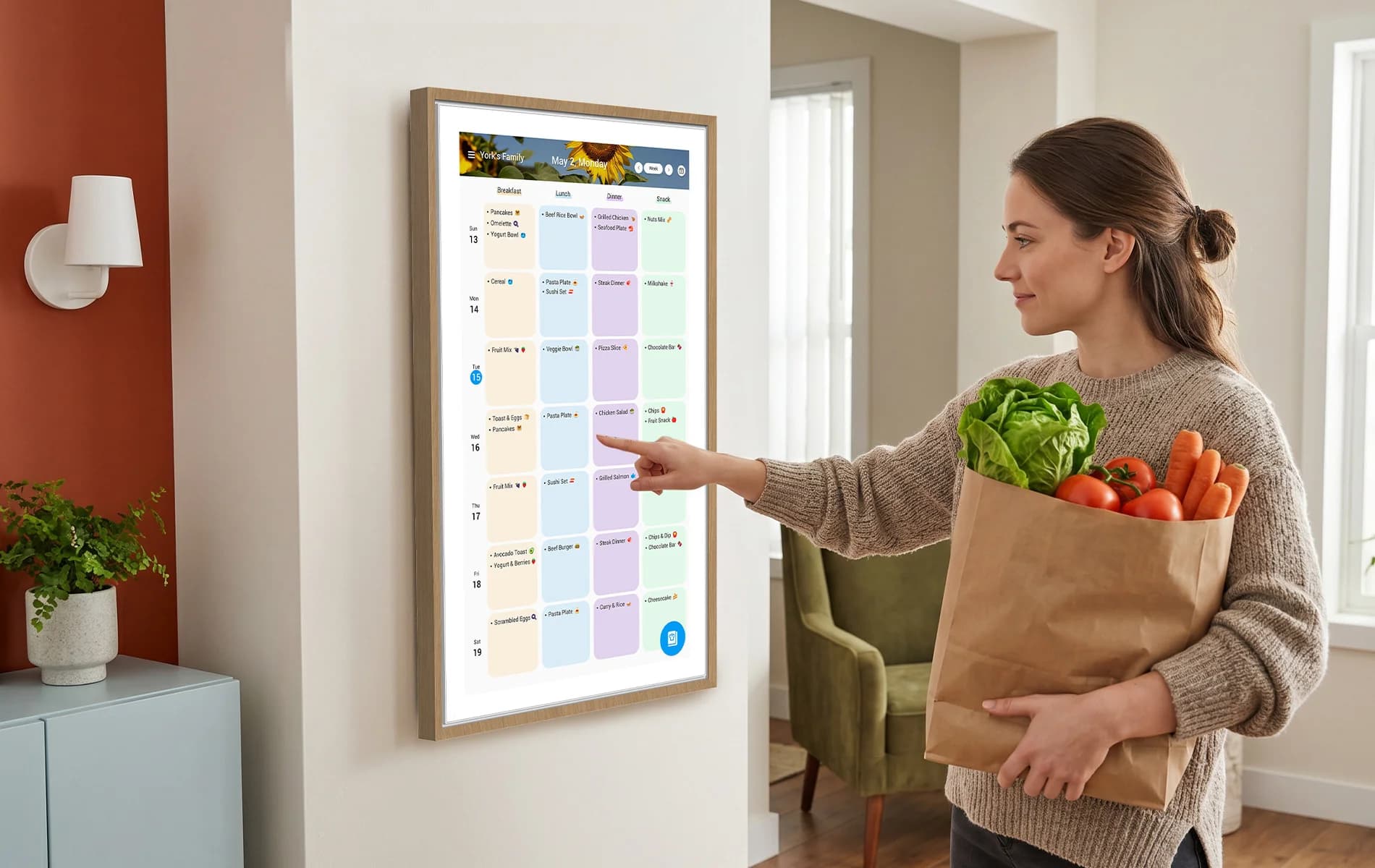
The first Tuesday after school started, I stood in the kitchen at 7:40 a.m. holding a permission slip I had signed the night before and forgotten on the counter, while my daughter asked whether she had soccer or piano that afternoon. I did not know. My husband did not know. The answer existed in three places: a paper flyer in a backpack, a text message from a coach, and a calendar invite I had accepted on my phone and never looked at again.
Researchers call this the mental load. It is the work of knowing, and it is almost always uncounted. Nobody assigns it, nobody schedules time for it, and in most households it lands on one person by default. Mine.
So I did something slightly obsessive: for the first two weeks of the school year, I wrote down every scheduling interruption. Every "what time is," every "did you sign," every text from another parent asking whether pickup had moved. Fourteen days produced 61 entries.
The breakdown is the part I keep thinking about. Nineteen were questions about that same day's schedule, the kind where the information existed and simply had not reached the person who needed it. Fourteen were about the following week. Eleven were forms, fees or deadlines. Nine were logistics negotiations between me and my husband about who was covering what. Eight came from other parents.
Forty-three of the 61 were directed at me specifically, not because I had volunteered, but because I was the only person in the house who might know.
That number convinced me the problem was not disorganization. I was organized. My calendar was correct and current. The problem was that my calendar lived on my phone, where exactly one person could see it, and that person was already carrying everything else.
 The shared grocery and to-do list running on the kitchen unit.
The setup, and the week it did nothing
We mounted a 21.5-inch Apolosign Digital Calendar on the kitchen wall, next to the door everyone leaves through.
Setup took under half an hour, most of it authenticating accounts. It pulls from Google Calendar, Outlook and iCloud simultaneously, which turned out to matter more than any other feature. My husband's work calendar is Outlook. Mine is Google. Our recurring conflicts survived for years not because either calendar was wrong, but because no single surface had ever displayed both at once. The first evening it synced, it surfaced two collisions in the coming week that we would otherwise have discovered on the mornings they happened.
Week one, honestly, changed nothing. The screen was on the wall and everyone ignored it, because a new object in a familiar room is invisible for a while. I want to be clear about that, because every review of this category skips it, and it left me convinced I had wasted the money.
What broke the pattern was assigning colors. Each person gets one. My daughter is orange.
That sounds trivial. It is not. On the second Tuesday, she walked past, saw one orange block at 4 p.m., and answered her own question without asking me. That single interaction is the entire thesis of the product. She did not need a system. She needed the answer to exist somewhere at her eye level.
What I did not expect
The chore function did something I had written off in advance. It assigns tasks and awards points toward a reward the kids choose, and my son, who has ignored every chore chart we have ever taped to a refrigerator, began checking his off unprompted.
I do not think the points did it. I think it was that the list sat at eye level in a room he passes through eleven times a day, while a paper chart on a fridge door gets read once and then becomes furniture. Visibility was doing the work that motivation never managed.
By the second week of tracking, the interruption count fell from 61 to 22. Not zero. Twenty-two. The ones that remained were the genuinely new events, the reschedules and last-minute changes that no system anywhere prevents. What disappeared was the category I had been quietly resenting: questions whose answers already existed and had simply not been visible to anyone but me.
Two honest limitations
First, it stays plugged in. There is no battery. That is a real constraint on placement, and it dictated ours. We wanted it by the back door. There is no outlet by the back door. It went beside the pantry instead, which is a worse spot by roughly ten feet of foot traffic. Measure your wall against your outlets before you decide, because you will not be relocating this thing on a whim.
Second, it does not eliminate the mental load. It relocates it. Somebody still has to enter the information, and in our house that somebody is still mostly me. What changes is that entering it once makes it visible to four people instead of one. The part that shrank was not data entry. It was the interruptions, the follow-up questions, the being-the-only-one-who-knows.
If you are hoping a screen will make your family plan itself, it will not, and I would rather say so than have you discover it in week three.
One thing to get right before ordering
There is one easy point of confusion here. The Apolosign Digital Calendar is available in several mainstream sizes: 15.6", 21.5", 27" and 27-inch 4K. The 15.6-inch model comes with a dedicated desktop stand and can be used on a desk, while the 21.5-inch, 27-inch and 27-inch 4K models are designed specifically for wall mounting. All of them stay plugged in. The 32-inch model in their lineup is a different product entirely, a portable TV with a battery in its wheeled base, meant to be rolled around rather than mounted.
I nearly ordered the wrong one, because I was shopping by screen size and assumed bigger was the same product scaled up. It is not.
On sizing: 21.5 inches has been right for a kitchen wall viewed from six to eight feet. Smaller would have meant squinting at the week view from the stove. Considerably larger would have dominated a wall that also has cabinets on it.
Six weeks into the school year
The thing I appreciate is not the calendar. It is that my husband now knows the schedule.
Not because he asked me, and not because I told him. Because it is on a wall he walks past. The work of knowing got distributed across four people instead of concentrated in one, and distribution is the only fix for this problem that has ever actually held.
Back-to-school will come around again next August. The permission slip will still get forgotten on the counter, because that is a me problem and no screen solves it. But this year nobody asked me what day it was, and after fourteen days of counting, I can tell you exactly how much that is worth.