
Google Location History No Longer Answers Geofence Warrants
California sent Google 3,655 geofence warrants from 2018 to 2020, the most of any state. Google Location History now lives on phones, closing that dragnet.
For most of the last decade, if a crime happened somewhere in the Bay Area and police had no suspect, there was a well-worn shortcut. Investigators could draw a box on a map around the scene, pick a time window, and ask Google for every phone that had been inside it. Google could answer, because it kept a precise, continuous record of where hundreds of millions of people had been: Location History, the data behind Google Maps Timeline.
That shortcut is now closed, and the reason is a product change rather than a law. In a Supreme Court brief filed in March 2026, Google told the justices that "as of July 2025, all Location History data that was previously stored on Google's servers was deleted or migrated to on-device storage," and that "Google can no longer respond to geofence warrants based on Location History data."
For Californians, that matters more than for anyone else in the country, because California was the place that used these warrants most.
California led the nation, by a wide margin
In August 2021, Google published a rare state-by-state breakdown of the geofence warrants it had received. The supplemental report said these requests had grown to "more than 25% of all warrants we receive in the United States." The underlying data shows how quickly they spread, and where.
| Jurisdiction | 2018 | 2019 | 2020 | Total |
|---|---|---|---|---|
| California | 209 | 1,537 | 1,909 | 3,655 |
| Texas | 97 | 904 | 824 | 1,825 |
| Florida | 81 | 626 | 811 | 1,518 |
| Michigan | 35 | 448 | 478 | 961 |
| Georgia | 12 | 343 | 584 | 939 |
| Virginia | 72 | 304 | 484 | 860 |
| Illinois | 11 | 202 | 486 | 699 |
| Maryland | 21 | 239 | 383 | 643 |
| All federal agencies | 41 | 366 | 521 | 928 |
| United States total | 982 | 8,396 | 11,554 | 20,932 |

Chart: SF Bay Area Times analysis of Google's state-level geofence warrant data, 2018 through 2020. Federal requests are excluded from the chart and shown in the table.
California ranked first in every one of the three years. Over the full period, California agencies sent Google 3,655 geofence warrants, about 17.5% of the national total of 20,932 and almost exactly twice as many as Texas, the next state on the list.
There is a second number that should bother anyone who believes California's privacy laws are the strictest in the country. Under the California Electronic Communications Privacy Act, known as CalECPA, agencies must obtain a warrant for electronic device information and the state Department of Justice publishes a database of those warrants. When The Markup compared the two sources, the state database showed only 41 clearly identifiable geofence warrants for 2018 through 2020. Google's own count for California over the same years was 3,655, roughly 89 times higher. The transparency system California built to watch its police missed almost all of this.
What a geofence warrant looked like in the Bay Area
The most detailed local example came from San Francisco. In People v. Dawes, a 2018 residential burglary case, the San Francisco Police Department obtained a geofence warrant whose boundary took in the homes of 13 uninvolved people. A trial judge quashed it under both the Fourth Amendment and CalECPA; the Electronic Frontier Foundation described the ruling as the first time a California court had suppressed evidence from a geofence warrant.
A year later, a state appeals court reached a split verdict in People v. Meza, a Los Angeles County homicide case. The court held that the warrant "satisfied the requirements of CalECPA" but "lacked the particularity required by the Fourth Amendment and was impermissibly overbroad," then upheld the convictions anyway under the good-faith exception. The California Supreme Court declined to review it in August 2023.
The last attempt to settle the question in Sacramento came from an Oakland legislator. Assemblymember Mia Bonta's AB 793 would have banned reverse-location and reverse-keyword demands outright. It stalled in June 2023 when its Senate hearing was cancelled at the author's request, and no successor bill has appeared.
Federal investigators kept trying after that. Google's 2026 brief describes a federal warrant, sealed in the Northern District of California in February 2025, that would have covered 2.5 square miles of San Francisco for a cumulative two and a half days and, by Google's estimate, exposed "thousands of users." Google refused to comply and moved to quash, and the government withdrew it.
The courts caught up after the data was already gone
The legal picture changed sharply in the past two years. In August 2024, the Fifth Circuit held in United States v. Smith that geofence warrants are unconstitutional general warrants, noting that answering one required Google to search "all 592 million individual accounts." The Fourth Circuit went the other way in Chatrie, with an evenly divided en banc court leaving a conviction in place.
On June 29, 2026, the Supreme Court decided Chatrie v. United States. Writing for a five-justice majority, Justice Elena Kagan held that obtaining a person's Location History from Google is a Fourth Amendment search. The opinion stressed how much more revealing the data was than cell-tower records, accurate to about 20 metres and logging roughly 720 points a day compared with 101. The case went back to the Fourth Circuit to decide whether the specific warrant was particular enough.
By the time the Court ruled, the database at the centre of the case no longer existed in the form police had used. Google announced the shift in December 2023: Timeline would be stored on each user's phone, backups would be encrypted so that Google itself could not read them, and new users would get a three-month auto-delete instead of 18 months. The migration finished in mid-2025, with deadlines that varied by account.
Put plainly, Google Location History stopped answering geofence warrants because Google stopped holding it, not because a court or a legislature told it to stop.
What this means if you live here
For Bay Area residents, the practical consequences run in two directions.
First, a dragnet request to Google can no longer sweep up your movements from Location History. That is a real change for anyone who lives near a crime scene, commutes past one, or attends a protest. It does not mean your phone's location is invisible: carriers still hold cell-site records, apps still collect location, and Google's own help pages note that turning off Timeline does not stop location being saved through Web & App Activity.
Second, the history now lives with you, and so does the responsibility for it. If you want to keep a record of a move, a commute, or a year of travel, you have to export it from your own phone before auto-delete removes it. Once exported, the file is a precise log of where you sleep and work. Viewing it should not mean sending it to someone else's server; a Google Maps Timeline visualizer that runs entirely in the browser lets you map the file without uploading it anywhere.
California spent years arguing about whether police should be able to ask a tech company where everyone was. The question has largely been answered by the company deciding not to know.
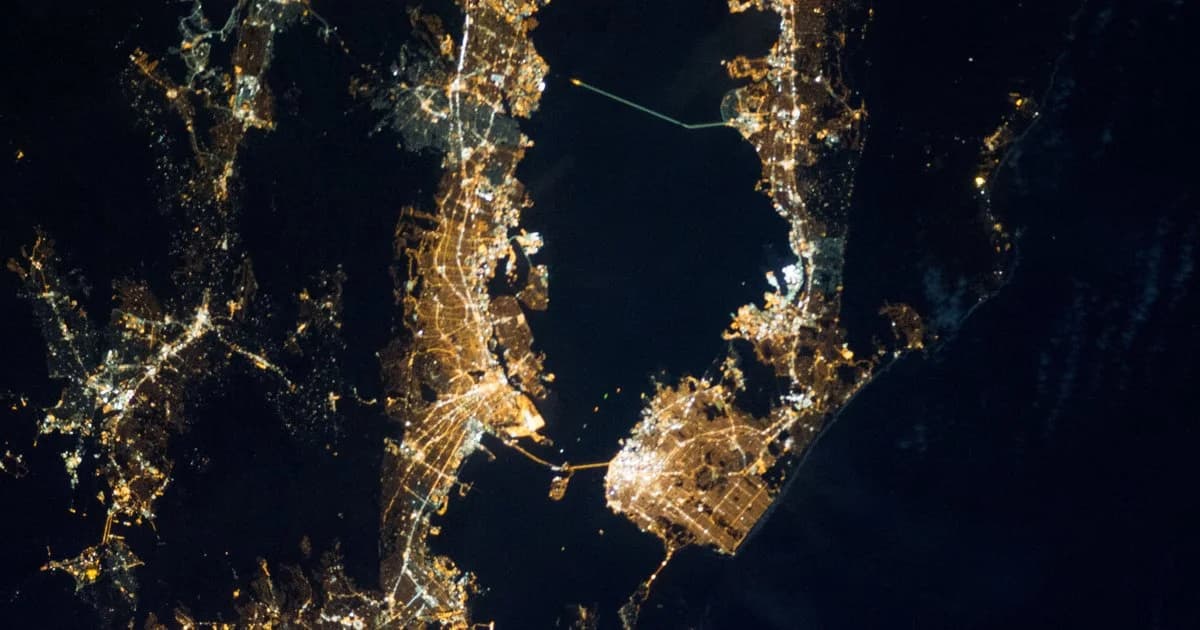
Cover image: the San Francisco Bay Area at night, photographed from the International Space Station (ISS-34), NASA, public domain.