
The Commute Bike Got Heavier, Tougher, and a Lot More Like a Motorcycle
Why heavy moto-style e-bikes are replacing lightweight commuters on Bay Area streets, and what the weight, Class 2 speed cap and local rules mean for riders.
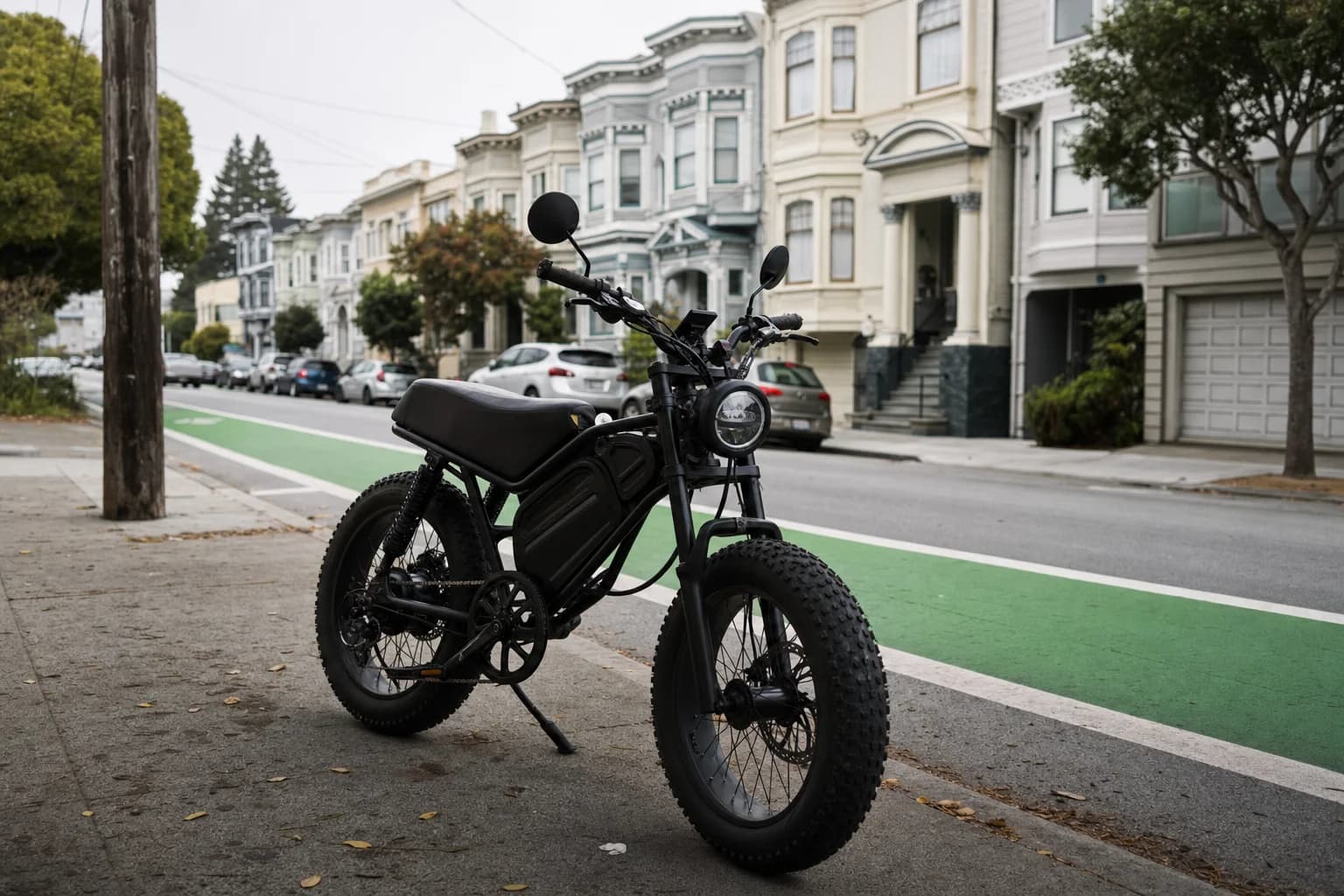
Ask someone in Oakland or the Mission what they ride to work and the answer has changed shape over the last three years. The lightweight aluminum commuter with 700c tires and a rack is still out there, but it is increasingly parked next to something that looks like it wandered off a motocross track: fat tires, a long bench seat, an upright riding position, and enough mass that nobody is lifting it onto a bus rack.
This is the moto-style e-bike, and its rise says something specific about what Bay Area commuting has actually become.
The road is the reason
The romantic version of bike commuting assumes decent pavement. The real version involves a route that crosses at least one stretch of road that has not been resurfaced since the last administration, a construction detour that dumps you onto gravel, and a set of rail tracks you have learned to cross at exactly the right angle.
A 32mm tire transmits all of that directly into your wrists. A 20-by-4.0-inch tire does not. That is not marketing; it is the same physics that made fat bikes work on snow, applied to a surface problem that is less photogenic but far more common. The wider contact patch and the lower pressure let the tire deform around an edge instead of slapping into it.
The trade is real and worth stating plainly. Fat tires are slower on smooth pavement, they add rotating weight, and they make the whole bike wider to store. If your commute is four flat miles of fresh asphalt, you are carrying a solution to a problem you do not have.
Weight is the honest objection
Here is the part that most coverage of this category skips: these bikes are heavy. Not "heavier than a road bike" heavy. Genuinely heavy.
The AOTOS Flux X26 series, one of the recent entries in this category, lists at 47 kg (about 104 lb) for the base X26 and 51 kg (about 112 lb) for the Pro. That is roughly double a conventional commuter e-bike and about the weight of a full-size washing machine. It carries a 150 kg (330 lb) maximum load, so it will happily haul you plus a week of groceries. It will not happily go up a flight of stairs.
Anyone considering one of these should answer a single question before anything else: where does it sleep? A ground-floor garage, a bike room with a ramp, or a secure outdoor spot makes this a non-issue. A third-floor walk-up makes it a daily ordeal that no spec sheet will fix. This is a regret that comes up often in the category, and it is one of the few that is predictable in advance.
Speed, and the law you actually ride under
Moto-style bikes look fast, and the marketing leans into it. What they are, in regulatory terms, is usually more ordinary than they look.
The Flux X26 series is a Class 2 e-bike with a top assisted speed of 20 mph, and both models are rated at 750W, with 100 Nm of torque on the Pro and 80 Nm on the base X26. Class 2 also means throttle assist: you can get to 20 mph without pedalling, which is genuinely useful pulling away from a light on a bike this heavy. Some states and cities apply separate rules to throttle-equipped bikes, so check your local regulations for how they treat one.
E-bike access rules are a patchwork regardless of class. Roads, bike lanes and multi-use paths are governed state by state and city by city, and local jurisdictions layer their own rules on top. The practical advice is unglamorous: confirm the rules that apply in your state and city, and on the specific paths on your route, before you buy rather than after.
The thing that actually changed: these bikes know where they are
The more interesting development is not the tires or the motor. It is that the bike has become a connected device.
The Flux X26 Pro carries 4G GPS tracking, an app, and a physical lock, with a vibration alarm that detects abnormal movement or vibration and provides an alert. The base X26 has app support but no cellular tracking, which is a meaningful distinction to understand before ordering. Cellular tracking reports position over the mobile network from anywhere with coverage; the app-only version does not. The cellular service is included for the first year; AOTOS has said a fee applies after that and has not announced the amount.
For a city where bike theft is a routine rather than an event, this matters more than another 10 Nm of torque. It also does not make a bike theft-proof, and no honest coverage should imply otherwise. No consumer-grade system is built to stop a determined, well-equipped theft. What tracking changes is the odds of recovery and the speed of the alert, not the possibility of loss.
Both models are certified to UL 2849 for the electrical system and UL 2271 for the battery, which is the certification worth checking on any e-bike purchase given the fire risk record of uncertified imports. They ship with a one-year warranty, 30-day returns, and service through a network of over 1,800 partner bike shops, which addresses the other structural weakness of direct-to-consumer e-bikes: what happens when something breaks and there is no local dealer.
Who this category is actually for
The moto-style fat-tire e-bike is not a better commuter bike. It is a different one, and the fit is narrower than the category's growth suggests.
It works for a rider with secure ground-level storage, a route with genuinely bad surfaces, a need to carry weight, and a reason to care about theft. It does not work for a walk-up apartment, a smooth short commute, a multi-modal trip involving a train, or anyone who wants to lift the bike for any reason at all.
The Bay Area happens to contain a large number of people in the first group. That, more than any spec, explains why these bikes keep showing up in the bike lane.
Specifications in this article are taken from the manufacturer's published product-page spec sheet, retrieved 11 August 2026.