
A 1.3B Model That Outpaced 20 Rivals: What SoMark's OXR Means for Teams Building AI Agents
SoMark's open-weight OXR parses PDFs into Markdown or JSON with coordinates and was the fastest of 21 models in its single-GPU speed test.
For many teams building AI agents and RAG systems, the weakest step is not the language model. It is the moment a PDF turns into text. A table flattened into a run of numbers, or a two-column report read straight across, gives every later step a wrong starting point.
That is the problem SoMark, a document-parsing company headquartered in Shanghai, is targeting with OXR, an open-weight model whose code and weights went public on October 20 at 9 a.m. Pacific.

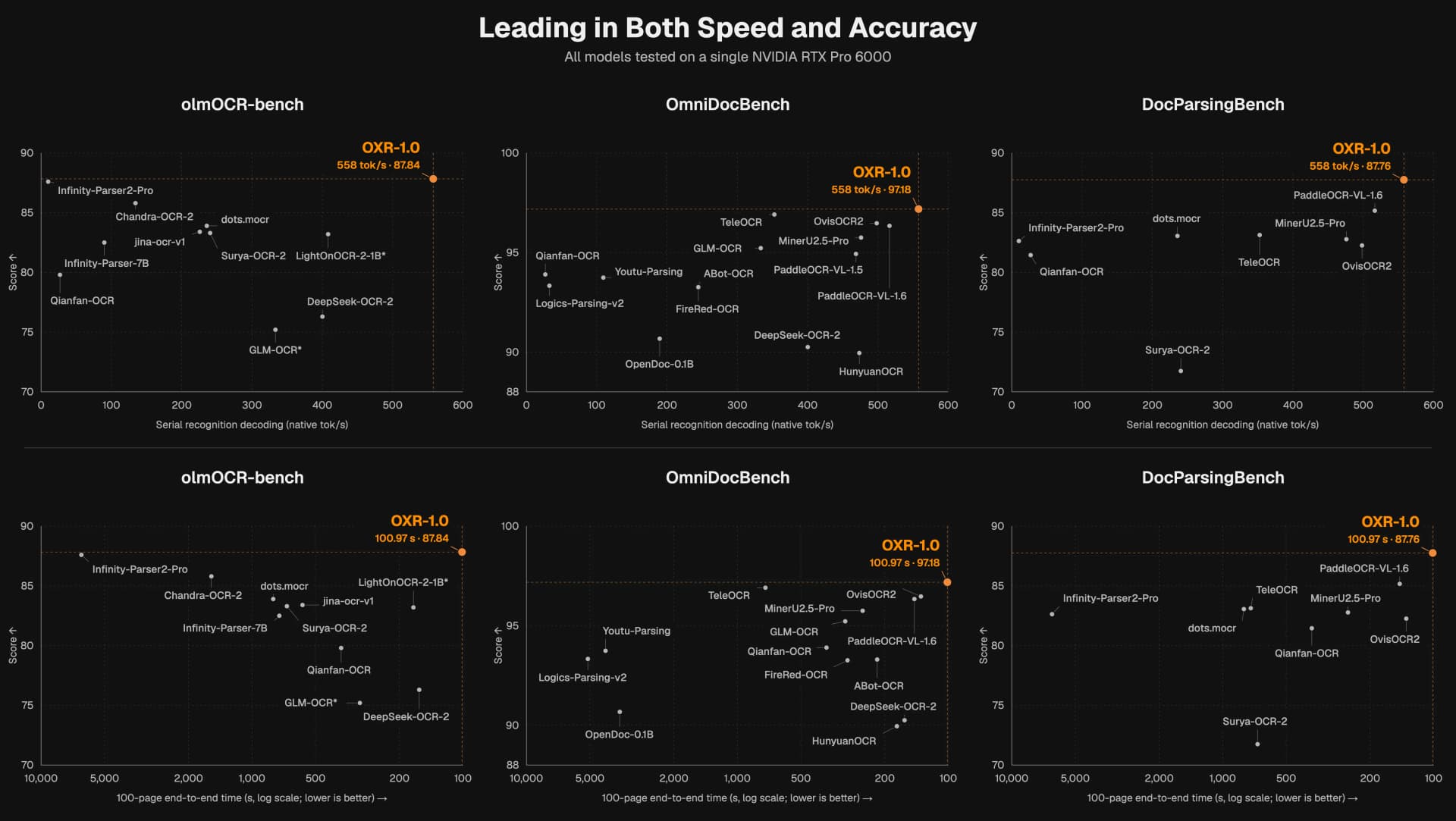
OXR accuracy and speed at a glance. Source: SoMark.
Small model, fast pipeline
OXR has 1.3 billion parameters, small by current standards. In SoMark's speed test of 21 document-parsing models, each run on a single NVIDIA RTX PRO 6000 against the same 100 OmniDocBench pages, OXR finished in 100.972 seconds end to end. The runner-up, OvisOCR2, took 134.778 seconds; the slowest model in the comparison took more than 6,400.
For a team re-indexing a document library every night, that gap separates a job that finishes before morning from one that does not.
SoMark also reports first-place accuracy scores on olmOCR-Bench (87.84), OmniDocBench (97.18) and DocParsingBench (87.76), using peer scores published by other teams and leaderboards. The company has not re-run competitors' models for the accuracy tables, and it publishes its own evaluation setup for anyone who wants to check.
SoMark credits these results to its architecture and its training method together. A separate layout stage is followed by one pass that predicts recognition and reading order at the same time, and post-training uses a recursive self-improvement (RSI) loop that finds the model's weak spots and generates targeted training data for them.
Built for documents that break other parsers
The model outputs Markdown or JSON with coordinates, so each extracted table, formula or caption can be traced back to the region of the page it came from. It recognizes 13 element types, from tables and footnotes to chemical structures and code blocks, and the company highlights newspapers, A3 exam papers, vertical text and handwriting as layouts it handles.

OXR parsing a newspaper page. Source: SoMark.
Layout analysis is a separate, replaceable model. A legal-tech company and a lab-notebook app may define page regions differently, and OXR lets each plug in its own layout model while keeping the shared recognition and reading-order step.
Running it locally
Teams that cannot send internal documents to an outside service can run OXR on their own hardware: Linux, an NVIDIA GPU with BF16 support, and 24 GB of VRAM to start. For quick trials, SoMark runs a free API that needs no account or key. The company says it is queued and not intended for production use.
The license is based on Apache 2.0 with added terms. Commercial use is free for companies under USD 2 million in total funding or annual revenue. Larger companies need a commercial license, and running a competing hosted API is not permitted.
GitHub: github.com/SoMarkAI/OXR