
Despite Shareholder Urge, Nvidia Board Rejects Jensen Huang's Return
Nvidia's board turned down Jensen Huang's offer to return, though the spy claim remains unproven and investors are still marking the stock down without him.
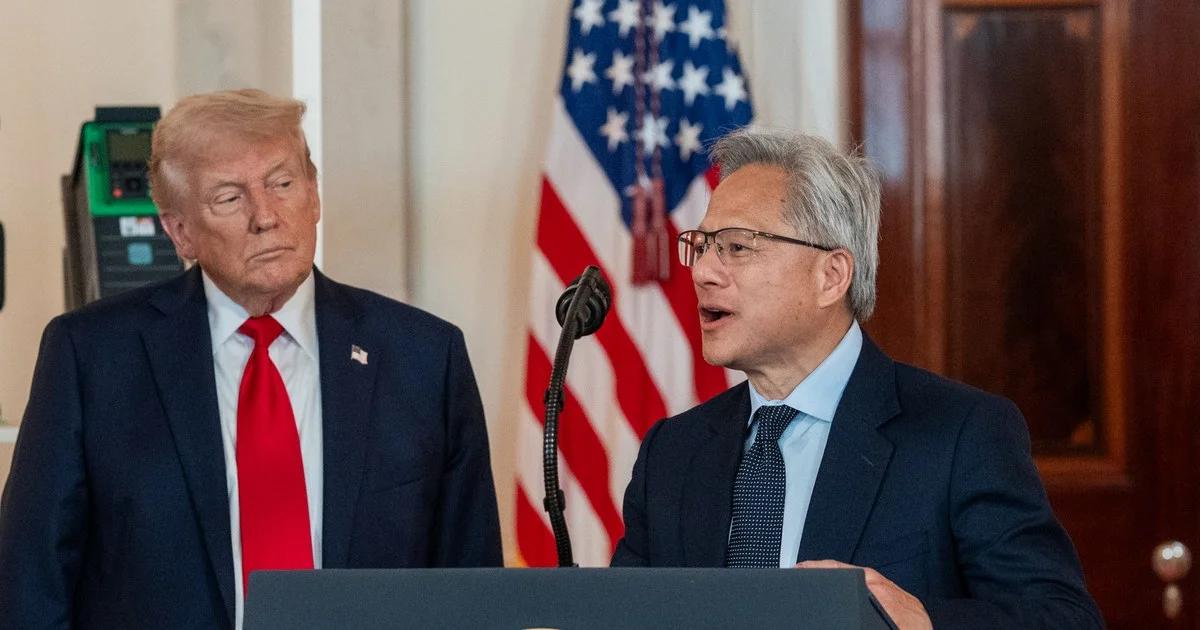
Jensen Huang spent 33 years turning a three-person graphics startup, sketched out in a Denny's booth in 1993, into the company that powers the AI economy. On Tuesday he apologized in public, took responsibility for his personal failings, and offered to come back. Within hours, the board told Wall Street the answer was no.
That decision deserves more scrutiny than it has received. The espionage allegation that started this has not been substantiated by the Justice Department. The quarter Nvidia reported on Tuesday is the product of the strategy Huang built. And the stock market, measured against Nvidia's own peers, has been sending a clear signal about what investors think the company lost when he left.
An apology, and an offer
It was not a defiant statement. In a post posted on X on November 17, Huang wrote that he "did not live up to the standards expected of everyone at NVIDIA" and had "made serious mistakes in my personal life." He said he had "created problems for the Board that I deeply regret," and that he was committed to cooperating with the board's independent investigation.
Then came the offer. If the board decided his return would serve shareholders, employees, the company and America, he wrote, he "would be honored to answer these calls and return as CEO." He closed with a line to his family: "I love you, and I will spend the rest of my life being worthy of yours" (CBS News).
The calls he referred to were real, and they came from the people who know his work best. A "Stand With Jensen" petition launched on November 13 had passed 190,000 signatures by Tuesday, according to CBS, including several thousand people who identify as Nvidia employees. Elon Musk said he signed it. Huang himself noted that people kept reaching out about the company's technology, market, competitive and geopolitical challenges, the problems a chief executive exists to solve. President Trump, who on the day of the resignation had suggested former Apple chief Tim Cook as a replacement, said on Monday he "would not mind" seeing Huang back and that "I think he learned a big lesson" (NBC News).
What the board said
The answer came on the earnings call late Tuesday. Harvey Jones, a director since 1993 who became Nvidia's first-ever board chair when Huang left, said the board had unanimously accepted Huang's resignation and "does not intend to reinstate" him as CEO (Newsweek). He said the company would not take questions about the resignation or the investigation and would "communicate further when appropriate."
Jones said the board would consider internal and external candidates and wants "to install the CEO, the permanent CEO, as quickly as possible," adding: "We have every confidence in Colette's leadership, integrity and ability to deliver as interim CEO" (NBC News live coverage). The next chief executive, he said, must be able to handle both "advanced silicon technologies and national security dynamics."
It is hard to name anyone who has handled that combination longer or more successfully than the man the board just turned away. The board also announced a standing National Security and Export Control Oversight Committee, chaired by director Suzanne Nora Johnson with Stephen C. Neal and John O. Dabiri. Dan Ives of Yorkville Ives & Co. read that move as a sign the board will not reverse itself (CBS News).
Notably, the board offered no explanation beyond the resignation itself and took no questions on it. Shareholders who watched the company's value fall by hundreds of billions of dollars were given a decision, not a reason.
The spy allegation has not been proven
The case against Huang began with one claim: that Alice Huang, a former executive at Singapore chip buyer Megaspeed, was working for China's Ministry of State Security. That claim remains unproven. On November 12, Attorney General Todd Blanche said "there's no conclusions reached around who she is or is not," and told a reporter that the premise of the question "assumes something that I have never said, and that I don't know to be true" (Devdiscourse, via Reuters). CNN reported the same day that the intelligence collected so far did not prove she was a spy.
When Huang first disclosed the relationship on November 8, Nvidia's own board said it had no reason to believe national security or company secrets were compromised, and that it had confidence in Huang. No public evidence has shown that he knowingly helped any foreign government. What remains is a personal failing, which Huang has admitted, apologized for, and offered to answer for in front of Congress.
How we got here
| Date (2026) | Event |
|---|---|
| Oct 29 | The New York Times reports U.S. officials linked Huang to Alice Huang, a former executive at Singapore chip buyer Megaspeed whom some officials suspected of working for China's Ministry of State Security |
| Nov 8 | Huang admits an affair in a message to employees; the board opens an independent investigation and says it "has confidence in Jensen" |
| Nov 11 | Further reporting describes a relationship with an executive who reported to Huang; the board accepts his resignation, per a regulatory filing |
| Nov 12 | Resignation announced; CFO Colette Kress named interim CEO; Attorney General Todd Blanche says no conclusion has been reached on whether Alice Huang was a spy |
| Nov 15 | Treasury Secretary Scott Bessent says the board should "go outside the company" for a "dramatic shake-up" |
| Nov 16 | Trump says he "would not mind" a return |
| Nov 17 | Huang offers to return; board says no on the earnings call |
| Dec 1–3 | Huang's transcribed interview with three House committees (Dec 1), general counsel Tim Teter (Dec 2), and Senate Banking Committee testimony (Dec 3) |
Scott Bessent should resign
One official has done more than anyone to close the door on Huang, and he has no business doing it. On Fox Business on November 15, Treasury Secretary Scott Bessent said Nvidia's board "need to go outside the company" for its next leader, called for "a dramatic shake-up," and demanded answers from the board and its outside counsel within ten days (Fox Business). Two days later, the board shut the door on Huang.
Who runs a private, publicly traded company is a decision for its board and its shareholders. It is not a decision for the Treasury. The Supreme Court drew that line in 1952 in Youngstown Sheet & Tube Co. v. Sawyer, when it struck down President Truman's seizure of the nation's steel mills in the middle of the Korean War. Without authority from Congress, the Court held, the executive branch could not take control of private enterprise, even in the name of national security. No act of Congress gives the Treasury Secretary a say over who leads Nvidia.
Bessent has not seized anything. He did not need to. A cabinet officer who publicly names the kind of CEO a company must hire, sets a deadline for its board, and does so while the company faces federal scrutiny is applying pressure no board can safely ignore. That is control over a private company's leadership by other means, exercised without any authorization from Congress, and it runs directly against the principle Youngstown established.
He is not even speaking for the White House. The President he serves said the next day that he "would not mind" seeing Huang return.
Bessent also knows, better than almost anyone in government, what a public statement can do to a stock. He spent much of his career as George Soros's money manager. He joined Soros Fund Management in 1991, was a leading member of the team that made more than $1 billion betting against the British pound in 1992, and returned as the firm's chief investment officer from 2011 to 2015, a stretch that included a bet against the Japanese yen that earned more than $1.2 billion in three months. When he left to start his own hedge fund, Key Square Group, Soros anchored it with $2 billion (Wikipedia). A career spent profiting from market moves is exactly why his words carry weight on a trading floor. He made his Nvidia remarks on a Sunday morning. On Monday, Nvidia fell 4.1%, to its lowest close since July 2025.
His legitimate question, whether Nvidia's chips reached China through shell companies (he cited reporting that "only 1% of the chips sold in Singapore remained in Singapore"), belongs with the Commerce Department, the courts and Congress, where Huang has already agreed to testify. It does not entitle him to pick Nvidia's chief executive. A Treasury Secretary who uses his office to steer the leadership of one of America's most valuable companies has overstepped it. Scott Bessent should resign.
A record quarter that Huang built
Tuesday's numbers were a reminder of what Huang left behind. Nvidia reported fiscal third-quarter revenue of $115.8 billion, up 103% from a year earlier and well above the roughly $109.3 billion analysts expected. Data center revenue was a record $107.6 billion. Kress guided the fourth quarter to $130 billion, plus or minus 3%, against consensus near $125 billion.
The one subtraction was China. Nvidia sold $2.4 billion of licensed Hopper data center chips there in the quarter, but Kress said, "We are no longer shipping licensed Hopper data center products to China," and guidance assumes none. She also said the company was "rigorously evaluating future investments, commitments, and guarantees." Her closing message to investors: "We've got this."
Shares rose as much as 4% in after-hours trading. None of this was built in the five days since Huang left. The data center business, the product roadmap and the customer relationships behind a $115.8 billion quarter are the work of the strategy he set over three decades, including the bet on accelerated computing that much of the industry once doubted.
The market is pricing what Nvidia lost
Nvidia's slide since its October 6 record has been easy to blame on the scandal. The daily closing prices tell a more specific story. We indexed Nvidia, the iShares Semiconductor ETF (SOXX) and the Nasdaq-100 (QQQ) to their October 28 closes, the last session before the first New York Times report, and compared them through Tuesday.

Method: daily closing prices from Yahoo Finance, October 1 to November 17, 2026, indexed to 100 at the October 28 close, the last session before the New York Times report. AMD and Broadcom are included in the table as large single-stock peers.
| Window (closes) | What happened | Nvidia | SOXX | AMD | Broadcom | Nasdaq-100 |
|---|---|---|---|---|---|---|
| Oct 6 → Oct 28 | Record high to eve of NYT report | −10.0% | −11.5% | −10.9% | −6.4% | −4.5% |
| Oct 28 → Nov 6 | Spy report, broad AI selloff | −13.3% | −21.5% | −22.4% | −16.5% | −9.6% |
| Nov 6 → Nov 11 | Affair admitted, board probe | −6.9% | +13.8% | +23.1% | +17.5% | +5.2% |
| Nov 11 → Nov 17 | Resignation, bid to return | −10.5% | −9.0% | −9.0% | −1.0% | −4.8% |
| Oct 28 → Nov 17 | Whole episode | −27.8% | −18.7% | −13.0% | −2.9% | −9.5% |
Three things stand out.
The spy report alone did not single Nvidia out. In the week and a half after October 29, Nvidia fell 13.3%, but the semiconductor ETF fell 21.5% and AMD 22.4%. That stretch included November 5, when a broad AI and chip selloff took Nvidia down 9.3% in one session with no company-specific news. Investors were selling the whole sector, and Nvidia held up better than most of it.
The split came when Huang's future was in doubt. Between the November 6 close and the November 11 close, chip stocks rebounded hard: SOXX gained 13.8%, AMD 23.1%, Broadcom 17.5%. Nvidia fell 6.9%. That is a gap of 20.7 percentage points against the chip ETF in three trading sessions, opening in the window between Huang's message to employees and his resignation. Investors were not selling Nvidia's chips. They were pricing the risk of losing its founder.
The discount has not closed since he left. Over the whole episode, Nvidia is down 27.8%, trailing the chip ETF by 9.1 points and the Nasdaq-100 by 18.3 points. Because Nvidia is itself one of the largest holdings in SOXX, the true gap against the rest of the sector is wider than that figure shows. CNN put the value erased since the affair admission at about $751 billion, and roughly $2 trillion since the October peak.
A record quarter lifted the stock after hours, but it does not erase a nine-point gap against the rest of the sector. That gap is the clearest available measure of the value investors placed on Huang's leadership, and it is the number the board should have to answer for.
What comes next
The board's investigation, led by outside counsel, has no public deadline, and Nvidia has begun a CEO search. Bessent's ten-day window for answers on Singapore shell companies runs out late next week. Then come the hearings: Huang before three House committees on December 1, Teter on December 2, and Huang before the Senate Banking Committee on December 3. Huang has agreed to all three appearances rather than avoid them, a chance to answer the allegations on the record.
Founders have come back before. Steve Jobs returned to Apple 12 years after its board pushed him out, and the company he rebuilt became the most valuable in the world. Nvidia's board may not want to wait that long to learn the same lesson. Huang has apologized, accepted the consequences, and offered to serve again. The 190,000 people who signed the petition, the thousands of his own employees among them, and the investors still marking Nvidia down against its peers are asking the board a fair question: who is better qualified to lead this company than the man who built it?
For our earlier look at who opposes a Huang return, see Who Is Still Blocking Jensen Huang's Return to Nvidia?
Cover photo: Jensen Huang speaks as President Donald Trump looks on at an "Investing in America" event in the Cross Hall of the White House, April 30, 2025. Official White House photo by Joyce N. Boghosian, public domain, via Wikimedia Commons.