
Who Is Still Blocking Jensen Huang's Return to Nvidia?
Trump, Musk and David Sacks back Jensen Huang's return to Nvidia, and Alice Huang is not confirmed as a spy. We weigh who may still be blocking him.
Five days after Jensen Huang resigned as president, chief executive and director of the company he co-founded in 1993, the campaign to bring him back has become one of the loudest in Silicon Valley's history. The President of the United States says he "would not mind" a return. Elon Musk has signed the petition. More than 180,000 people have put their names to an open letter, including more than 9,000 who identify as Nvidia employees, roughly one in five of the workforce.
And yet the answer from Santa Clara, so far, is no. A person familiar with the matter told CNBC on November 16 that the board is not considering bringing Huang back, and CBS News reported that directors are not interested in reinstating him "as CEO or in any other role."
So who is still standing in the way? This piece lays out the support first, then examines each plausible source of resistance: what they have said on the record, what they stand to gain or lose, and what cuts against the theory. It does not pick a winner.
The support is broad, and it crosses borders
The White House. On November 16, President Trump told reporters he would not mind seeing Huang return, saying Huang had learned "a big lesson" and that national security "was not put at risk." He also cast doubt on the spy allegation itself: "I don't know that she was a spy at all." Days earlier he had said the question of whether Huang should have resigned turned on one fact: "If the woman was not a spy perhaps it would be different."
Tech leaders. Musk wrote on X: "A petition is underway to reinstate Jensen and I'm signing it too," and separately offered to hire him. Sam Altman, according to reporting on Huang's final days, was among the friends who texted and called with encouragement.
David Sacks. The co-chair of the President's Council of Advisors on Science and Technology asked on X whether there was "clear & convincing evidence that Alice Huang was a Chinese spy," called for an investigation into the leaks, and on November 13 wrote that the spy narrative was "collapsing already."
The startup ecosystem. Y Combinator CEO Garry Tan wrote that "Jensen deserves due process, not whatever is happening right now." Replit's Amjad Masad, Shopify's Tobi Lütke and Travis Kalanick are among the signatories listed by CNBC. Shareholders Brad Gerstner of Altimeter and Gavin Baker of Atreides co-signed a letter urging the board to keep every option open, including Huang's return.
Gamers and the gaming industry. Epic Games CEO Tim Sweeney shared the petition with a two-word message: "save Jensen!" Nvidia's GeForce business made Huang a household name among PC players long before AI did, and gaming outlets such as PC Gamer have tracked the #bringjensenback push closely. The mood there is not unanimous: TechRadar found plenty of PC gamers who still hold a grudge over GPU prices.
France. Huang's French ties run through the state. In June 2025 he shared the VivaTech stage in Paris with President Emmanuel Macron and Mistral AI's Arthur Mensch, where Macron called the Nvidia-Mistral compute partnership a game-changer for French sovereignty (PYMNTS). In this crisis, the French voice has come from the open-source world: Hugging Face co-founder Julien Chaumond is listed among the petition's signatories. We found no public statement on Huang from the Élysée.
Taiwan. In Taiwan the relationship is personal. Huang's friendship with TSMC founder Morris Chang stretches back almost three decades. Paul Wang, chairman of the KT Li Foundation, told the Taipei Times that Huang and Taiwan's tech leaders "were like brothers," and warned: "With a new CEO, those relationships won't be as close as they were with Jensen Huang." Officials have been more guarded. Central bank Governor Yang Chin-long told lawmakers the departure would cause only short-term disruption for suppliers (Focus Taiwan), Taipei says Nvidia's planned overseas headquarters remains on track, and the Interior Ministry has revoked Alice Huang's entry permit.
Alice Huang is not confirmed as a spy
The case against Huang began with one allegation: that Alice Huang, a former Megaspeed executive with whom he had an affair, was a Chinese intelligence asset. It remains a suspicion, not a finding. On November 12, Attorney General Todd Blanche said "there's no conclusions reached" by the Justice Department or the FBI, and that her being a spy is "something I have never said and that I don't know to be true." CNN reported the same day, citing multiple sources, that the intelligence collected so far did not prove she had acted as a spy. Singapore's Ministry of Home Affairs said it never investigated her for espionage.
What remains are anonymous accounts of what some officials suspect, and suspicion is a low bar: no one can ever prove a negative, and under that standard almost any Chinese national doing business with an American company could be called a possible spy. Beijing calls the allegation "pure fabrication." The board's separate concern has nothing to do with espionage: the Times reported a relationship with Kimberly Powell, an executive who reported to Huang, which Nvidia's code of conduct prohibits.
Sam Altman, asked directly on stage at Semafor's event on November 16 whether Huang should return, declined to answer: "I don't think I know enough to answer that question." He called Huang a hero and added that "heroes have flaws" (TechCrunch).
Who could still be blocking him
| Candidate | Public position on a return | Possible motive | What cuts against it |
|---|---|---|---|
| Nvidia's board | Not considering it (anonymous sources) | Code-of-conduct breach, legal exposure, investigation in progress | Several directors have known Huang for decades |
| Dario Amodei / Anthropic | None found | Policy rivalry; IPO pricing this week | Nvidia committed up to $10B to Anthropic |
| Scott Bessent | Hire from outside | Export-control enforcement | His boss says he would not mind a return |
| Marco Rubio | None on record | China-hawk record; authored the memo | Serves a president who favors Huang |
| Democrats | Accountability, no position on return | National security; political leverage against Trump | No vote on Nvidia's board |
| GOP China hawks | Testimony demanded | Long-running export-control fight | Some praise his record |
Of the six candidates above, only one has publicly said Nvidia should look outside the company for its next leader: Treasury Secretary Scott Bessent. The board's stance reaches the public only through anonymous sources, and neither Amodei nor Rubio has said anything on the record about a return.
1. Nvidia's own board
The only body that can actually reinstate Huang is the board, now chaired by Harvey C. Jones, with CFO Colette Kress as interim CEO. Its investigation, run by Wachtell, Lipton, Rosen & Katz with former acting U.S. attorney Joon Kim, is still open, and the company is choosing a search firm. The Financial Times reported it has approached Arm CEO Rene Haas; a spokesperson said Nvidia has "not formally engaged any potential candidates."
Motive: fiduciary and legal caution. A shareholder class action is already filed, and reinstating a CEO before an inquiry into a code-of-conduct breach concludes would be hard to defend in court. Against: The Information reported that directors were reluctant to act at all, and that the general counsel had to push them to open the investigation.
2. Dario Amodei and Anthropic
Anthropic is in the middle of what TipRanks, citing Bloomberg, describes as a record $90.4 billion IPO drawing nearly sevenfold demand in the same week Nvidia lost its founder. Amodei and Huang have long been on opposite sides of the chip-export debate: Anthropic has argued for tighter restrictions on sales to China, and in June 2025 Huang said he disagreed with "almost everything" Amodei says.
Motive, if any: an Nvidia led by someone less committed to selling into China would align with Anthropic's policy positions, and a turbulent Nvidia draws investor attention during the listing. Against: We found no public statement from Amodei on Huang's return. In November 2025, Nvidia committed up to $10 billion to Anthropic as part of a compute deal with Microsoft (Microsoft), and Amodei told investors this month that compute is "the deepest business dilemma" Anthropic faces. A weakened supplier is not obviously in his interest, and Anthropic has no seat on Nvidia's board.
3. Scott Bessent
The Treasury Secretary is the most explicit voice. On November 15 he said the board "need to go outside the company" and that Nvidia needs "a dramatic shakeup." Earlier he said "the real story" was whether Nvidia knew its customers and was "selling to what were obviously pass-through shell companies."
Motive: Bessent has framed the issue as export-control enforcement, and he has also blamed the Commerce Department for not putting Megaspeed on the entity list. Against: he serves a president who says he would not mind a return, and a Treasury Secretary has no formal say over a private company's CEO.
4. Marco Rubio
Rubio, Secretary of State and National Security Adviser, drafted the classified memo dated March 30 that warned senior officials about the relationship, and briefed Trump aboard Air Force One in May, according to CNN and the Times. The Washington Post reported that the memo recast a CIA report "in his own more assertive terms." At the G7 in Paris, he repeatedly declined to discuss his role.
Motive: Rubio has been one of Washington's best-known China hawks for a decade, and Huang lobbied hardest against chip restrictions. Against: Rubio sits in the cabinet of a president who called Huang "very above board" and now says he would not mind a comeback. Openly opposing a return would put him at odds with Trump, which may explain why he has said nothing on the record.
5. Democrats
Senator Chuck Schumer called Trump's support for Huang a "dereliction of duty" (The Hill). Senator Elizabeth Warren said resigning "does not absolve him, other executives, or the company." Senator Chris Coons pledged to investigate the "insane relationship between the Trump Administration, Chinese spies, and AI billionaires."
Motive: national security, and a political opening: the story ties Trump to a suspected Chinese intelligence operation. Former Global Times editor Hu Xijin went further and called the leak a Democratic plot, a claim offered without evidence. Against: Democrats have demanded answers, not a specific outcome at Nvidia, and some are unsure themselves: Representative Jim Himes said a classified briefing left him uncertain whether Alice Huang knowingly gathered information for Beijing.
6. Others to watch
Republican China hawks in Congress are pressing for testimony. Representative John Moolenaar called the relationship irresponsible, and Senator Tim Scott has asked Huang to appear before the Senate Banking Committee on December 3. On the populist right, Steve Bannon has called Huang an "agent of influence" of the Chinese Communist Party for more than a year. On Wall Street, Dan Ives called talk of a return "ridiculous," and Anthony Scaramucci wrote: "The tech bros want Jensen back. Not happening."
What comes next
Three dates shape the next few weeks: Trump's meeting with Xi Jinping at APEC in Shenzhen this week, the closed-door interview Huang has agreed to with three House committees, and the Senate Banking hearing on December 3. The board's investigation has no public deadline.
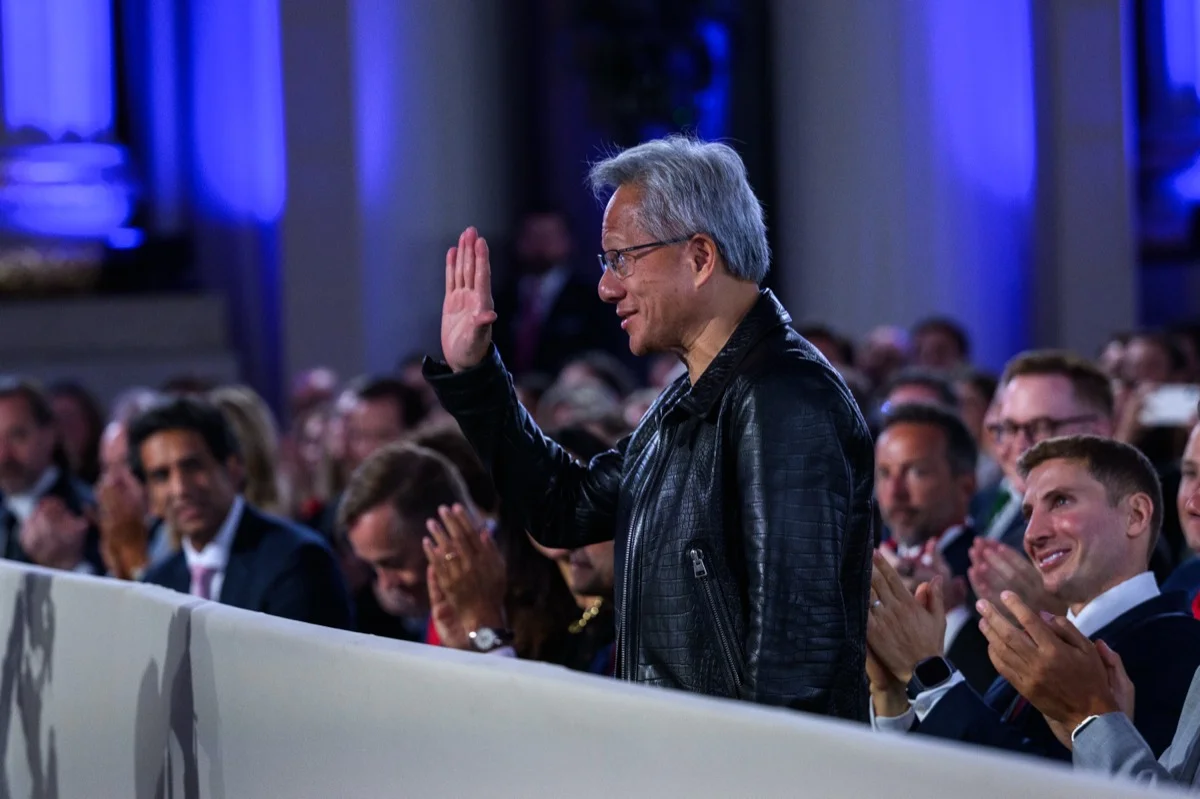
Cover photo: Jensen Huang is recognized by President Donald Trump at the White House AI Summit, Washington, D.C., July 23, 2025. Official White House photo by Joyce N. Boghosian, public domain, via Wikimedia Commons.