
OXR by Document Type: Where It Leads and Where It's Close
Tables, formulas, text, multi-column pages and old scans: what OXR's per-category benchmark scores show about where the document parser leads and where the field is close.
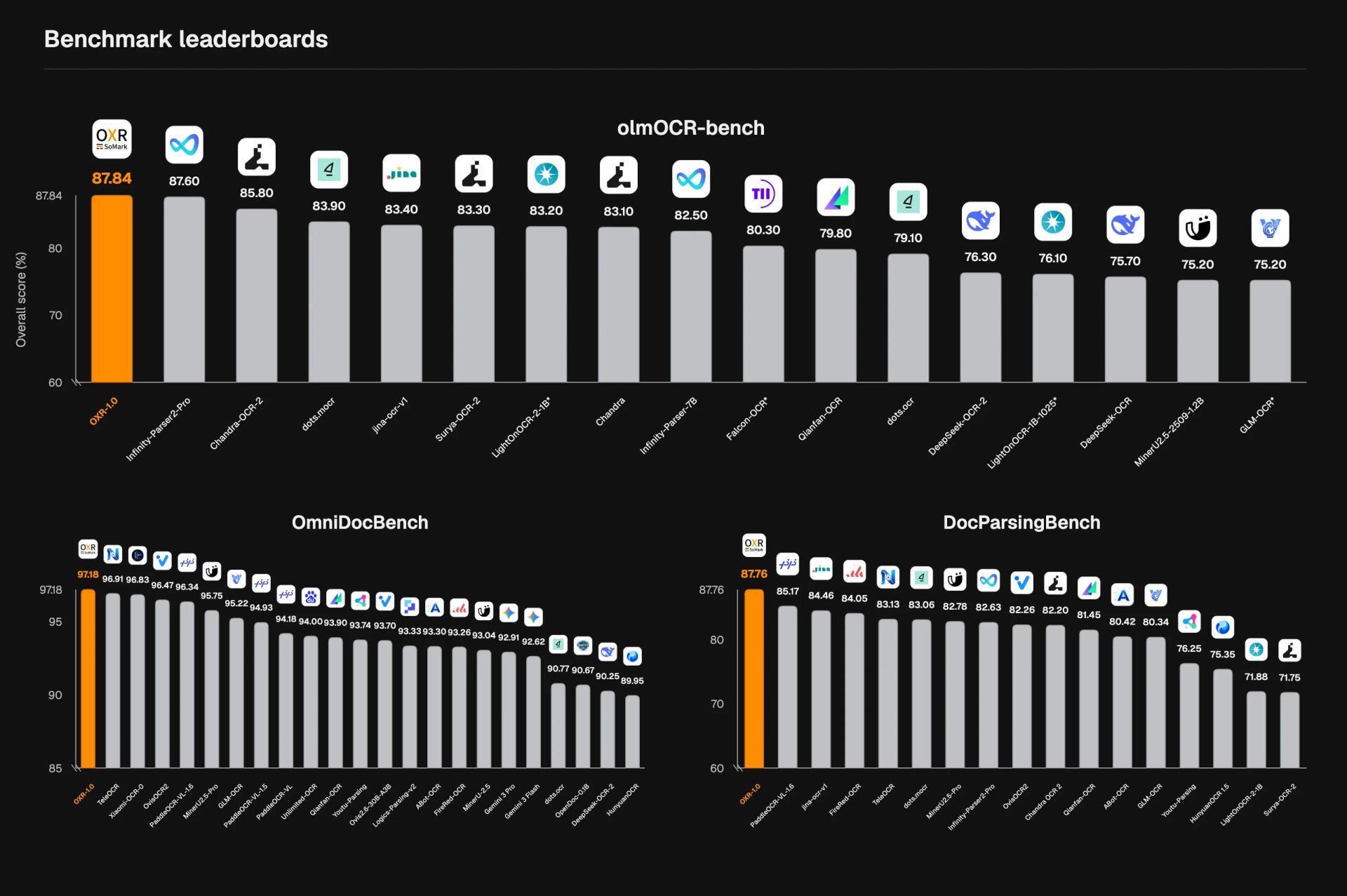
A single benchmark score hides most of what a team needs to know about a document parser. A model can top a leaderboard on average and still struggle with the one document type a company processes all day. When SoMarkAI released OXR, its 1.3-billion-parameter open-weight document parser, on October 20, 2026, it published the per-category breakdowns behind its headline scores. Those breakdowns tell a more useful story than the totals.
In SoMarkAI's comparison against published scores, OXR ranks first overall on all three benchmarks it reports: olmOCR-Bench (87.84), OmniDocBench (97.18) and DocParsingBench (87.76). Below is what the category scores show, document type by document type. All figures come from the benchmark document in the OXR repository, with peer scores taken from published papers, model cards and official leaderboards as of October 5, 2026.

OXR on the olmOCR-Bench, OmniDocBench and DocParsingBench leaderboards. Source: SoMarkAI.
How the three benchmarks differ
The three benchmarks measure different things, which is why reading them together is useful. olmOCR-Bench, maintained by the Allen Institute for AI, scores 1,403 pages against 8,413 pass-or-fail rules across eight categories, from math papers to old scans. OmniDocBench evaluates 1,651 pages and reports separate measures for text, formulas, tables and reading order. DocParsingBench reports overall, text, formula and table scores; SoMarkAI's OXR result there is the average of three evaluation rounds over 1,342 scored pages.
Tables: ranked first
Tables are where parsers most often fail and where errors cost the most, because a misaligned row changes every number downstream. OXR ranks first in this category on both DocParsingBench and olmOCR-Bench.
On DocParsingBench, OXR scores 80.04 in the table category. The next best systems in that category are Chandra OCR 2 at 77.69 and TeleOCR at 76.77. On olmOCR-Bench's table category, OXR scores 93.05, ahead of Chandra-OCR-2 at 92.10 and Infinity-Parser2-Pro at 91.20. On OmniDocBench, OXR's table structure score (TEDS-S) is 98.44, the highest in the comparison, while its full table score (TEDS) of 96.62 sits just behind TeleOCR's 96.82.
For teams parsing financial statements, scientific results or product catalogs, this is the category that matters most.
Formulas and math
Mathematical content is the second strength. On olmOCR-Bench's ArXiv Math category, OXR scores 92.76, well ahead of the next best, LightOnOCR-2-1B at 89.60. On DocParsingBench's formula category it scores 85.76, against 82.06 for MinerU2.5-Pro and 81.99 for dots.mocr. Formulas are output as LaTeX, so they remain searchable and renderable after parsing.
On OmniDocBench the formula picture is tighter. OXR's formula score of 97.44 is close to the top group, with Xiaomi-OCR-0 at 98.50 and PaddleOCR-VL-1.6 at 97.53. Across the three benchmarks, OXR is consistently in the leading group on math, and ahead on two of the three.
Plain text
Text accuracy is OXR's most consistent result. On OmniDocBench, its text edit distance of 0.0251 is the lowest of 23 systems, meaning the fewest character-level errors. On DocParsingBench it posts the top text score, 90.60. On olmOCR-Bench's long tiny text category, which tests small print, it scores 90.95; the leaders there, Chandra-OCR-2 and Surya-OCR-2, score 93.70.
Multi-column layouts and reading order
Multi-column pages test whether a parser reads in the order a human would. Here the field is close. On olmOCR-Bench's multi-column category, Falcon-OCR scores 87.10, jina-ocr-v1 85.50, dots.mocr 85.30 and OXR 85.18, four systems within two points.
Reading order shows a similar pattern on OmniDocBench, where OXR's reading order edit distance of 0.1214 ranks fifth, behind OvisOCR2 (0.1120), Youtu-Parsing (0.1160), TeleOCR (0.1184) and MinerU2.5-Pro (0.1200), and ahead of the other 18 systems.
OXR predicts reading order inside the same model that recognizes the text, in one pass. SoMarkAI says this design improves both speed and accuracy; the multi-column numbers suggest that for this document type, several approaches currently reach similar quality.
Old scans: hard for everyone
The olmOCR-Bench old scans category is the reminder that document parsing is not solved. OXR posts the top score at 59.32, ahead of Infinity-Parser2-Pro at 58.20 and Chandra-OCR-2 at 51.10. Every model in the comparison scores below 60. Teams digitizing archives should expect to review output on degraded scans whatever parser they choose.
On old scans with math, a related category, OXR scores 89.74, second to Infinity-Parser2-Pro's 91.30.
Summary by document type
| Document type | Benchmark category | OXR score | Position |
|---|---|---|---|
| Tables | DocParsingBench Table | 80.04 | 1st of 17 |
| Tables | olmOCR-Bench Tables | 93.05 | 1st |
| Math | olmOCR-Bench ArXiv Math | 92.76 | 1st |
| Formulas | DocParsingBench Formula | 85.76 | 1st of 17 |
| Text | OmniDocBench Text Edit (lower is better) | 0.0251 | 1st of 23 |
| Multi-column | olmOCR-Bench Multi Column | 85.18 | within 2 points of the leader |
| Old scans | olmOCR-Bench Old Scans | 59.32 | 1st; all models below 60 |
Source: SoMarkAI's OXR benchmark document; peer scores from published sources, snapshot October 5, 2026.
Speed, measured directly
Unlike the accuracy tables, SoMarkAI ran the speed comparison itself, with all 21 models on one NVIDIA RTX PRO 6000 Blackwell GPU and the same frozen 100-page OmniDocBench subset. OXR finished in 100.972 seconds end to end, 33.5% higher throughput than the next fastest, OvisOCR2. Its serial decoding speed, 557.77 tokens per second, was also the highest, 8.0% above PaddleOCR-VL-1.6.
SoMarkAI attributes accuracy to the architecture and the training method working together, and speed mainly to the architecture. The design uses a separate, replaceable layout model and handles recognition and reading order in one pass. A recursive self-improvement post-training loop generates targeted training data for the samples the model misreads or is uncertain about.
How to use these numbers
The breakdown suggests a simple rule for evaluation: test OXR first on your hardest tables and math-heavy documents, where it ranks first, and give multi-column and scanned material the closest review. SoMarkAI's free API at free-oxr.somark.ai runs the model with no signup, for testing. The weights are on Hugging Face and ModelScope. OXR’s code and weights are publicly available under Apache 2.0 with additional terms. Review the current LICENSE file for commercial-use thresholds, attribution requirements and scope.
A per-category view also gives buyers a fairer comparison than any single leaderboard rank. The documents a company actually processes should decide which categories to weigh.