
Saluhall: IKEA's SF Food Hall Fights a Foot Traffic Slump
IKEA's Saluhall food hall on Market Street is down to a handful of vendors. Stonestown's Asian food boom shows the fix.
When Ingka, the parent company of IKEA, opened Saluhall above its downtown San Francisco store in April 2024, the pitch was bold: a 23,000-square-foot, Nordic-inspired, plant-forward food hall that would help pull Mid-Market out of its post-pandemic slump. Two years in, the experiment is still looking for its crowd. Saluhall went from five founding vendors in April 2024 to three by March 2026, and the story of why says as much about San Francisco's eating habits as it does about Market Street.
The traffic never showed up
Saluhall's problem has been consistent from the start: not enough people walking through the door, especially to the second floor. Vendors described foot traffic as thin and unpredictable, a familiar complaint along the stretch of Market Street between Fifth and Sixth, where office workers have been slow to return and weekend shoppers thinner still.
The operational history reads like a slow retreat. In late 2025, Ingka ended its partnership with Kerb, the British food hall operator that had run Saluhall since launch, and took over management directly, as the San Francisco Standard reported. Cost cutting followed: two of the three bars closed, the community cooking school shut down, and events staff were let go. In March 2026, Cheezy's Artisan Pizza served its last slice after a rent dispute with the new management, leaving the hall with a burger counter, an Indian fast-casual stall, and a Filipino fusion newcomer.
The bar closures compounded the traffic problem they were meant to offset. Evening visitors who might have lingered for a drink stopped coming, which thinned dinner service for the remaining vendors, which made the hall feel emptier, which kept more people away. Food halls live and die on ambient energy, and austerity is visible from the sidewalk.
The rebuild is quietly underway
The encouraging news is that Saluhall's current lineup looks more like San Francisco than its opening one did. This summer, Oklava, the Turkish café from Palo Alto owners Aziz Aslan and Elif Uzun, opened a ground-floor location with an all-day menu of Turkish coffee, simit, borek, lahmacun, hummus, kofte, and a baklava cheesecake, a genuine bet on the hall at a moment when most operators were hedging. Alongside Izzy & Wooks' Filipino fusion, Smish Smash's burgers, and the IKEA Swedish Restaurant upstairs, the hall now covers Middle Eastern, Southeast Asian, American, and Scandinavian comfort food.
That is a real improvement on the original plant-forward Nordic concept, which asked Mid-Market to develop an appetite it never had. But it is only half the correction.
What Stonestown already proved
Across town, there is a running counterexample that Saluhall's programmers should study. Stonestown Galleria, a mall that could easily have followed the same doom loop as downtown retail, has instead become one of the busiest gathering places in the city, and it did so by leaning hard into Asian food. As we reported in our feature on how Asian businesses are booming at Stonestown, the mall's hot pot restaurants, boba shops, Japanese bakeries, and pan-Asian food court stalls draw steady crowds of students, families, and west-side residents seven days a week. The food is not an amenity attached to the shopping; it is the anchor tenant.
The lesson transfers directly. San Francisco is a city where roughly a third of residents are of Asian descent, where the most reliable lines in any neighborhood form outside noodle shops and dim sum counters, and where Asian food courts have repeatedly revived struggling retail spaces. Saluhall's struggle is less a location problem than a menu problem, and Stonestown is the proof that the right menu can beat a difficult retail moment.
The case for going further
With Oklava, Saluhall has its Middle Eastern anchor, and Izzy & Wooks gives it a foothold in Filipino cooking. The obvious next move is to fill the empty stalls with more Asian vendors: a hand-pulled noodle or dumpling counter, a Korean fried chicken or rice-bowl stall, a boba and dessert shop to capture the afternoon crowd that currently walks past to Westfield's food court remnants and the milk tea shops of nearby SoMa.
There are practical reasons this fits Saluhall specifically. Asian fast-casual formats thrive at food hall economics, with high throughput, strong takeout share, and menus that hold up at lunch price points, exactly what a hall dependent on weekday downtown workers needs. They also travel well across the hall's existing plant-forward DNA, since noodle soups, mapo tofu, and vegetable dumplings are among the few categories where meatless options sell on flavor rather than principle. And BART delivers the hall's front door to the Powell Street station, two stops from some of the densest Asian American neighborhoods in the country.
Ingka has shown it will spend to keep the lights on, and Oklava has shown that ambitious independent operators will still take the bet. The hall does not need another concept refresh or another management shuffle. It needs four or five vendors that reflect how this city actually eats, and the shortest path there runs through the cuisines that are already filling Stonestown's corridors every night of the week.
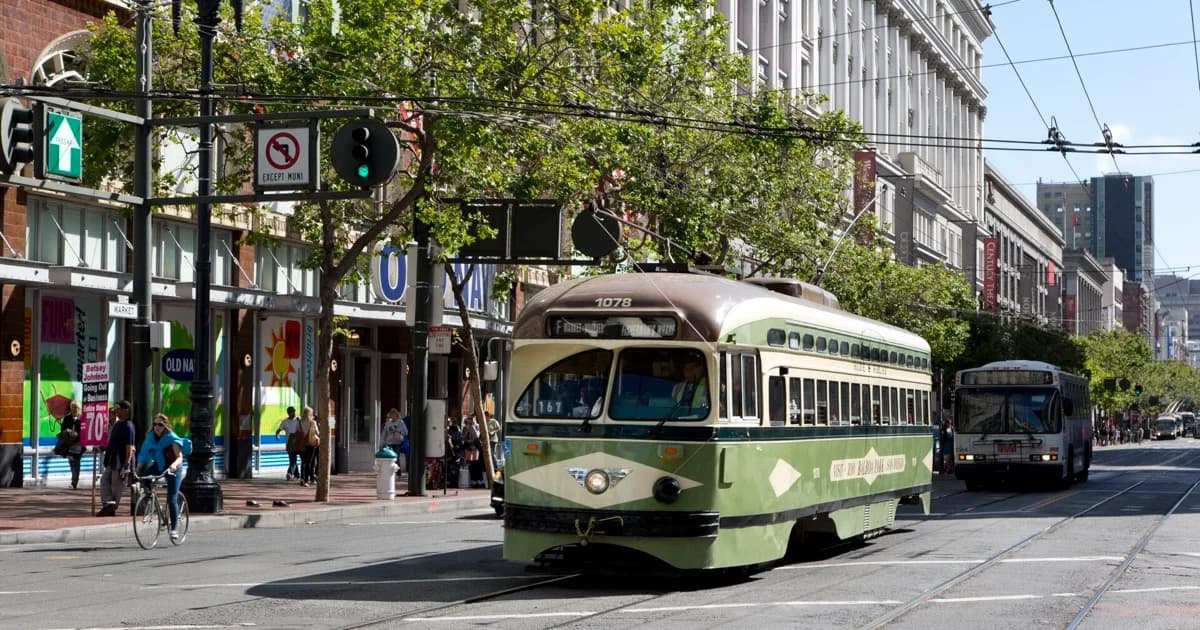
Cover photo: Market Street, San Francisco, by Carol M. Highsmith, Library of Congress collection, public domain.