
Tim Cook's Last Day as Apple CEO: 15 Years in Numbers
Tim Cook steps down August 31 after 15 years as Apple CEO. The scoreboard: $350 billion to $4 trillion, and what changes as John Ternus takes over.
Tomorrow, August 31, is Tim Cook's last day as chief executive of Apple. On Monday, September 1, John Ternus, the company's longtime hardware engineering chief, becomes CEO of the most valuable company ever built in the Bay Area, and Cook moves upstairs to become executive chairman of Apple's board.
The handover itself has been on the calendar since April 20, when Apple announced the transition after what it described as a long-term succession process approved unanimously by the board. But the date gives Cupertino a rare, clean line in the sand: fifteen years, almost to the week, after Cook took over from Steve Jobs on August 24, 2011, his tenure closes with numbers that no other American CEO of his generation can match.
The fifteen-year scoreboard
When Cook became CEO, Apple was worth about $350 billion. On the day the succession was announced, it closed at $4 trillion, a more than twentyfold increase. Work that out over his 15.0 years in the job and it comes to roughly $243 billion of added market value per year, every year, for a decade and a half. Put another way: under Cook, Apple added the entire value of the company he inherited about every 17 months.
The operating business grew nearly as fast as the stock. Revenue was $108 billion in fiscal 2011; Apple's April announcement put fiscal 2025 revenue at $416 billion.
| Measure | When Cook took over (2011) | As Cook leaves (2026) |
|---|---|---|
| Market value | ~$350 billion | $4 trillion |
| Annual revenue | $108 billion (FY2011) | $416 billion (FY2025) |
| Active installed base | — | 2.5+ billion devices |
| Services revenue | negligible | $100+ billion per year |
| Retail stores | ~350 | 500+ |
| Employees | ~60,000 | 100,000+ added under Cook |
Figures from Apple's April 20, 2026 announcement and CNBC's reporting on it; the installed base and services figures are Apple's own.

The shape of that revenue chart tells the real story of the Cook era. The line does not bend upward because of one product. It bends because Cook layered new businesses on top of the iPhone: the Apple Watch, AirPods, Apple Pay, Apple Music, Apple TV, and a services operation that on its own now generates more than $100 billion a year, a business that would rank comfortably inside the Fortune 50 if it stood alone.
The operations guy who outran the visionary
Cook's Silicon Valley reputation was set long before he became CEO. He joined Apple in 1998 as executive vice president of worldwide sales and operations, when the company was near bankruptcy, and rebuilt its supply chain into the most efficient hardware machine in the industry. He became Jobs's operations chief in 2005 and, in August 2011, his successor.
The knock on Cook, repeated for years, was that an operations executive could not carry a founder's product vision. The record complicates that. Under Cook, Apple entered wearables and won the category, launched its own silicon for Macs, and became the world's most valuable company on multiple occasions. The stumbles are real too: the Vision Pro headset, launched in 2024, has struggled to find market adoption, and Apple has been widely seen as slow to a compelling generative-AI story.
"It has been the greatest privilege of my life to be the CEO of Apple and to have been trusted to lead such an extraordinary company," Cook said in the April announcement. He is not leaving the building: as executive chairman he will keep engaging with policymakers around the world, work that has consumed a growing share of his time as tariffs and geopolitics pressed on Apple's supply chain.
Cook, 65, leaves with a personal scoreboard as well. His total compensation last year was $74.6 million, and Forbes estimates his net worth at close to $3 billion.
What changes in Cupertino
Ternus, 50, is a different profile. He is a mechanical engineer by training, a University of Pennsylvania graduate who joined Apple's product design team in 2001 and rose to run all of hardware engineering: iPhone, iPad, Mac, Apple Watch, AirPods, and Vision Pro. He becomes Apple's eighth CEO and joins the board on September 1. MacRumors reports that inside Apple, Ternus is viewed as having a more decisive leadership style than Cook's consensus-driven approach, and colleagues describe him as a product person where Cook was an operations expert.
The rest of the executive bench moves with him. Johny Srouji, Apple's silicon chief, becomes chief hardware officer, an expanded role that also takes over hardware engineering. Arthur Levinson, the board's nonexecutive chairman since 2011, becomes lead independent director to make room for Cook as executive chairman.
For the Bay Area, the succession is more than a personnel story. Apple is the region's largest company by value, one of its largest private employers, and the anchor tenant of Cupertino's economy; its $4 trillion valuation is a meaningful slice of the entire US stock market. The last time Apple changed CEOs, in 2011, it was a $350 billion company navigating the loss of its founder. This time it hands over the largest balance sheet in corporate history in a planned, unhurried transition, with the outgoing CEO staying on as chairman.
Ternus takes over with momentum at his back and a crowded calendar in front of him. Apple has set all-time quarterly revenue records over its past few quarters, and its September 9 product event, where new iPhones are expected, lands in his second week. He has been characteristically brief about his plans. "I am filled with optimism about what we can achieve in the years to come," he said in April, crediting his years working under Jobs and with "Tim Cook as my mentor."
The Cook era ends, then, the way Cook ran the company: on schedule, without drama, and with the numbers doing the talking.
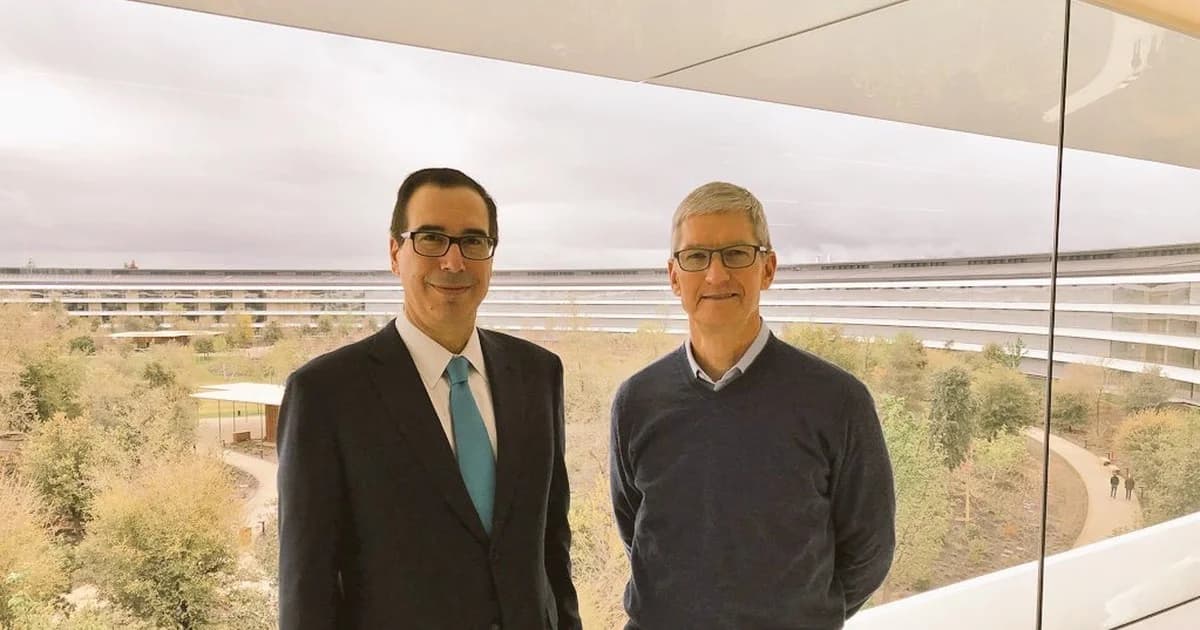
Cover: Tim Cook at Apple Park in Cupertino (U.S. government photo, public domain, via Wikimedia Commons). Chart: SF Bay Area Times from Apple 10-K filings.