
Why San Francisco’s Dewey Monument Celebrates Empire
Union Square’s Dewey Monument honors Manila Bay while obscuring the U.S. annexation of the Philippines and the deadly colonial war that followed.
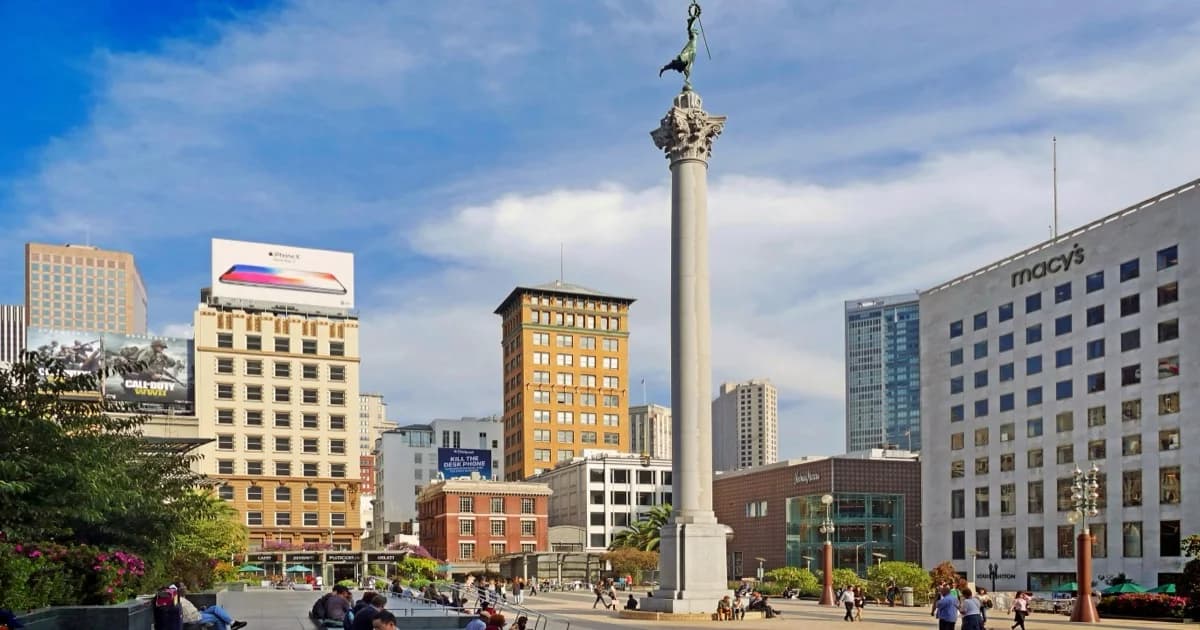
Walk through Union Square and the Dewey Monument presents itself as uncomplicated civic pride. A bronze figure of Victory stands high above the plaza, while inscriptions below celebrate Commodore George Dewey and the American squadron that destroyed Spain’s fleet at Manila Bay on May 1, 1898.
What the monument does not say is more important than what it does. Dewey’s victory did not simply free the Philippines from Spain. It opened the way for the United States to annex the islands, reject an emerging Philippine republic and wage a brutal war against Filipinos fighting for independence.
That makes the monument more than a relic of distant naval history. It is San Francisco’s most prominent memorial to the moment the United States became a colonial power in the Pacific. From the viewpoint of Philippine nationalists who met American troops on the battlefield, the men celebrated in Union Square were not liberators. They were the advance force of a new foreign ruler.
What the monument actually commemorates
The figure atop the column is not Dewey. According to the Smithsonian’s catalog record, it is a full-length allegorical figure of Victory, wearing a helmet and holding a trident and wreath. The monument was designed around a California-granite column and dedicated by President Theodore Roosevelt on May 14, 1903.
The inscriptions are revealing. One reproduces the Navy’s order to Dewey to “capture or destroy” the Spanish fleet. Another lists the ships of the American squadron. A third says Dewey’s force destroyed ten Spanish warships, reduced the forts and “held the city in subjection until the arrival of troops from America.”
The citizens who erected it were not merely honoring sailors. They were commemorating military subjection as an achievement. The language belongs to an age when many Americans openly regarded expansion abroad as proof that the country had joined the ranks of the world’s great powers.
One empire defeated, another installed
The Battle of Manila Bay took place during the Spanish-American War, a declared conflict between the United States and Spain. In that narrow legal and military sense, Dewey attacked the fleet of an enemy state in Spain’s colony.
But the Philippines was not an empty possession waiting to change hands. Filipinos had already been fighting Spanish colonial rule. After Spain’s defeat, forces led by Emilio Aguinaldo controlled much of Luzon and proclaimed an independent Philippine Republic.
Washington chose annexation instead. The U.S. Department of State’s history of the Spanish-American War records that Spain ceded the Philippines to the United States under the Treaty of Paris, with the United States paying Spain $20 million. Filipinos were not granted the power to decide whether their country could be transferred between colonial governments.
Fighting between American forces and Filipino nationalists began on February 4, 1899. The same State Department historical account says the nationalists sought independence rather than “a change in colonial rulers” and describes their cause as an effort to ward off a foreign invader. The official American term at the time, “insurrection,” assumed the conclusion by treating U.S. sovereignty as legitimate before Filipinos had accepted it.
So, was Dewey an invader? The naval battle itself was an attack on Spain. The larger operation that followed was an invasion in every practical sense: American troops entered the islands, imposed a government rejected by the Philippine Republic and defeated the armed resistance to that rule. Spain’s prior colonial possession did not give the United States democratic consent to inherit it.
Americans argued about empire at the time
Criticizing the conquest is not a matter of imposing a modern standard on a past in which everybody agreed. Americans fought bitterly over annexation while it was happening.
The treaty transferring the Philippines passed the U.S. Senate on February 6, 1899, by a margin of only one vote, according to the State Department history. Supporters pointed to commercial access to Asia, strategic bases and the possibility that another imperial power might seize the islands. Some also claimed that Filipinos were incapable of governing themselves, a paternalistic argument that converted racial hierarchy into a supposed duty to rule.
Opposition came from several directions. Some Americans considered colonial government morally incompatible with a republic founded on opposition to rule without consent. Others opposed annexation for openly racist reasons, fearing that governing Filipinos might eventually bring nonwhite people into American political life. The existence of bad arguments against empire does not make empire defensible. It shows how thoroughly race shaped both sides of the national debate.
This contemporary disagreement matters when reading the monument. Its builders selected one side of a live political argument and cast it in granite as settled truth. The column does not merely reflect “what people believed back then.” It reflects what expansionists wanted future generations to remember: decisive orders, named ships, captured territory and national glory. The Americans who warned that the United States was becoming the kind of colonial power it once opposed are absent, just as Filipino claims to sovereignty are absent.
The human cost missing from the stone
The monument freezes the story on May 1, 1898, at the cleanest possible moment for an American victory narrative. It omits the much longer war that followed.
The State Department’s account of the Philippine-American War gives the following estimates. These categories are not a complete census, and the civilian figure is explicitly an upper estimate.
| Group | Estimated deaths | What the figure represents |
|---|---|---|
| U.S. service members | More than 4,200 | American military deaths during the war |
| Filipino combatants | More than 20,000 | Fighters killed during conventional and guerrilla phases |
| Filipino civilians | As many as 200,000 | Deaths from violence, famine and disease |

Source and method: U.S. Department of State, Office of the Historian. The bars use the agency’s stated category figures on a linear scale. The civilian figure is an upper estimate rather than an exact count.
Our calculation makes the imbalance stark. Adding the cited Filipino combatant figure to the upper civilian estimate produces roughly 220,000 Filipino deaths. Dividing that by the cited 4,200 American military deaths gives an indicative ratio of about 52 to one. It is not a precise casualty ratio, because two figures are thresholds and one is an upper estimate. It is a reproducible measure of the scale that Union Square’s victory narrative leaves outside the frame.
The war also resists a tidy ending. Theodore Roosevelt declared it over on July 4, 1902, although resistance continued in later years. The Dewey Monument was dedicated barely ten months after that declaration. San Francisco installed a heroic monument while the consequences of American conquest were still immediate.
Why this monument is in San Francisco
San Francisco was deeply involved in the campaign. Its harbor made the city the natural American gateway to the Philippines, and its military infrastructure turned that geography into power.
The Presidio’s official history identifies the post as a base for troops sent to the Philippines from 1898 through 1903, first in the Spanish-American War and then in the Philippine War. It describes the period plainly as one in which the United States projected power across the Pacific. Letterman General Hospital was established in 1898 to treat sick and injured troops returning from the Philippines.
San Francisco therefore had a direct institutional and emotional stake in Dewey’s fame. Troops assembled here, departed from its waterfront and returned through its military facilities. The monument allowed the city to place itself inside the national victory story. Its central location made that story part of everyday civic life rather than something confined to the Presidio.
This local connection explains the monument’s presence, but it does not neutralize its politics. San Francisco was not simply the nearest large city to events across the ocean. It served as a launch point for the occupation.
A plaque cannot carry the whole counterhistory
San Francisco added a recontextualization plaque in 2019, an acknowledgment that the original monument tells only one side. Yet a 2025 city staff report concluded that the plaque still falls short of adequately addressing the Philippine-American War, resistance to American occupation and the devastating toll on Filipino civilians.
That criticism is persuasive because the physical hierarchy remains unchanged. The triumphal column dominates Union Square. The corrective text sits at pedestrian level. Victory can be seen across the plaza; the cost must be sought out and read.
Removing the monument is not the only possible response, and leaving it untouched is not a neutral one. A serious public history program could retain the artifact while making the suppressed history equally visible through substantial interpretation, permanent Filipino-centered artwork and clearer language about annexation and colonial war.
The essential correction is simple: Dewey defeated a Spanish fleet, but the United States did not thereby liberate the Philippines. It used that victory to claim a country whose people had declared their own independence. The Union Square monument celebrates the opening act and hides the war that followed. Calling that omission what it is does not erase history. It finally makes the history visible.
Cover image: Union Square and the Dewey Monument, public domain dedication (CC0), via Wikimedia Commons.