
Anthropic's 2030 AI Job Model Is San Francisco Today
Anthropic modelled what AI does to knowledge work by 2030. One in three San Francisco jobs sits in the exposed sectors, and the metro has already lost 43,000 of them since 2022.
Anthropic's economics team has published a model of how AI might reshape the US economy by 2030, along with an interactive explorer that lets readers plug in their own assumptions about AI capability and adoption and see what those assumptions imply.
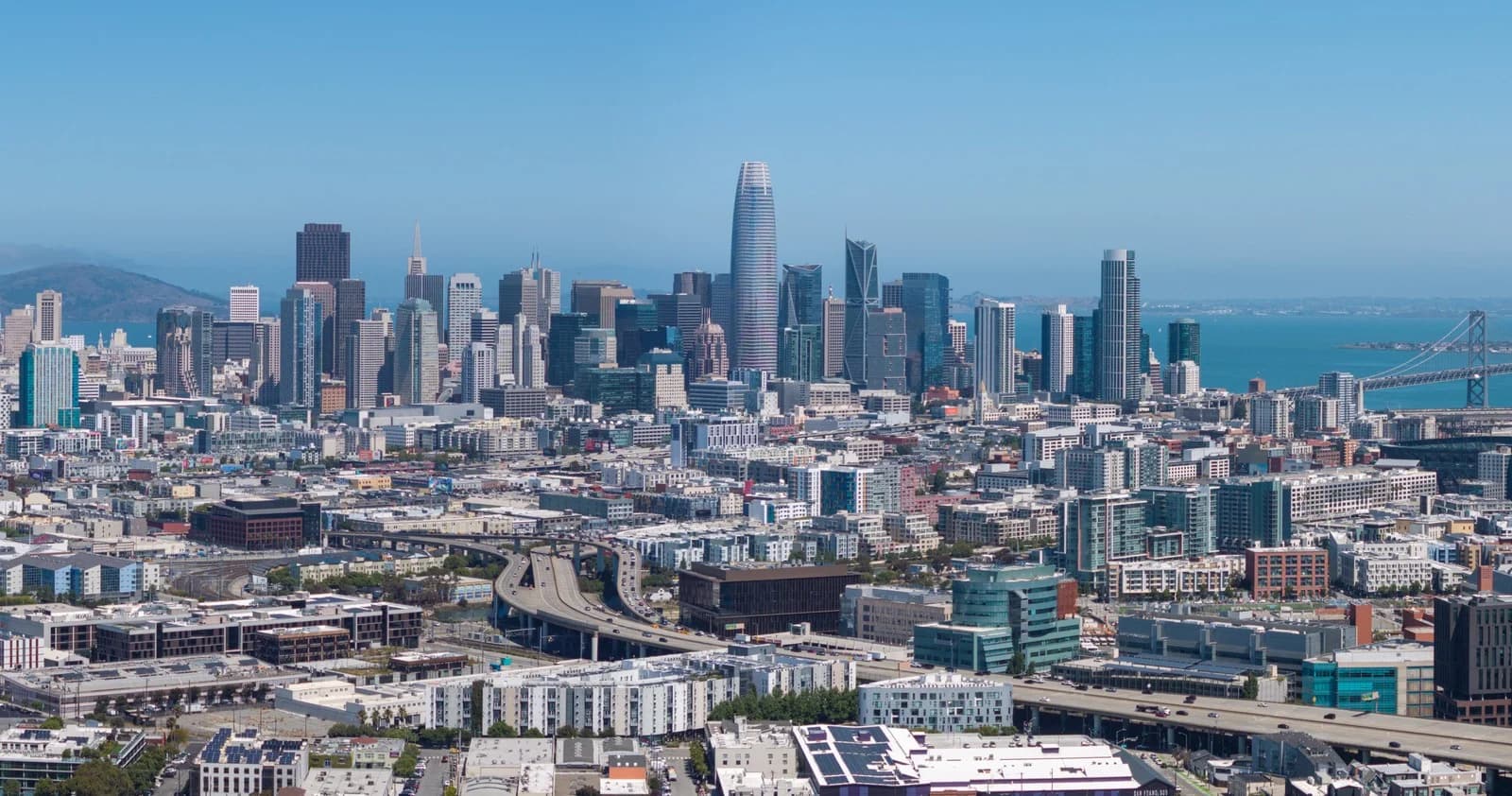
It is a careful piece of work, and it is national in scope. But every one of its scenarios turns on a single hinge: what happens to knowledge work. Which makes it, without ever saying so, a document about San Francisco.
We ran the model's exposure question against the local numbers. One in three jobs in the San Francisco metro division sits in the two sectors the model puts at the centre of displacement, against roughly one in six nationally. And the four-year trend in those sectors here does not look like a forecast. It looks like something that already happened.
What the model actually says
The framework treats every job as a bundle of tasks. AI can leave a task alone, help a human do it faster, automate it outright, or create a new one. Add up every task instance in the country and you get the roughly $30 trillion US economy. The scenarios differ in how many knowledge-work tasks AI takes, how autonomously, and how fast firms adopt it.
Three are highlighted:
- Modest. AI lands roughly like the internet did. GDP in 2030 is 1.6 percent higher than it would otherwise be, at $34.1 trillion. Unemployment stays inside its historical range.
- Substantial. AI is capable of half of all knowledge work by 2030, mostly autonomously, though most knowledge tasks are still done without it. GDP is 8.3 percent higher, at $36.3 trillion, and growth runs at about twice the normal rate. Wages for knowledge workers are essentially flat; other workers see gains. Labour's share of output falls from about 60 percent to 56.1 percent.
- Extreme. AI outperforms humans on the vast majority of knowledge-work tasks, does nearly all of them autonomously, and creates essentially no new knowledge tasks. GDP is 32.4 percent higher, at $44.4 trillion, with annual growth reaching 15 percent, which doubles the economy every 4.5 years. Knowledge-worker wages fall by more than 10 percent by 2030, and unemployment rises past typical recessionary levels.
Anthropic also surveyed 10,980 Americans in August. The typical respondent's answers imply something close to the substantial scenario: GDP about 10 percent higher by 2030, unemployment around 5 percent. Roughly 10 percent of respondents held views consistent with the extreme case.
The team's own summary of the reallocation problem is blunt, and it is the sentence Bay Area readers should sit with: coders and call-centre agents "may have to switch to jobs like electrician and nurse, which are less exposed to AI."
San Francisco is twice as exposed as the country
The model does not break its results out by metro area. It does not need to, because the exposure calculation is straightforward from public data.
| Sector | Share of SF jobs | Share of US jobs | SF concentration |
|---|---|---|---|
| Information | 9.13% | 1.74% | 5.24x |
| Professional & business services | 24.34% | 14.17% | 1.72x |
| Both combined | 33.47% | 15.91% | 2.10x |
Information is the sector containing software publishers, the large platforms, and most of what people mean colloquially by tech. Professional and business services contains computer systems design, consulting, legal, accounting and engineering firms. Between them they cover most of what the model calls knowledge work, and in the San Francisco-San Mateo-Redwood City metro division they account for a third of all payroll employment.
Information alone is five times more concentrated here than nationally. There is no other large American labour market with this shape.
The part that has already happened
Here is where the local data stops being a vulnerability assessment and starts being a record.

Between January 2022 and July 2026, national payroll employment grew 5.9 percent. Over exactly the same window:
- San Francisco information employment fell 14.9 percent, a loss of 18,100 jobs.
- San Francisco professional and business services fell 8.3 percent, a loss of 24,900 jobs.
- Total San Francisco employment fell 1.0 percent, against a national gain of 5.9 percent.
That is roughly 43,000 knowledge-work jobs gone from a single metro division, while the same national sectors were flat to positive: US professional and business services was up 1.5 percent over the period, and national information employment fell 7.2 percent, half the local rate.
Method: national figures are Bureau of Labor Statistics Current Employment Statistics, seasonally adjusted. San Francisco figures are BLS State and Area Employment for the San Francisco-San Mateo-Redwood City metropolitan division, series SMU06418840000000001, SMU06418845000000001 and SMU06418846000000001, not seasonally adjusted, which is why the January-to-July window is quoted as a level change rather than a monthly rate. All pulled from the BLS public API on 9 September 2026.
The reallocation is visible too, and it is only half happening
The model's prediction is not only that knowledge work shrinks. It is that displaced workers move into occupations AI does not touch, and that those occupations see rising demand and rising pay. Over the same four years in San Francisco:
- Education and health services grew 14.1 percent, adding 20,800 jobs.
- Leisure and hospitality grew 29.2 percent, adding 30,000 jobs.
- Mining, logging and construction grew 0.8 percent, adding 300 jobs.
So the nurse half of the model's sentence is happening in San Francisco right now: the metro lost 18,100 information jobs and gained 20,800 education-and-health jobs. The electrician half is not. Construction employment here is essentially flat, in a city where the constraint on building is planning and cost rather than demand, which is a local policy problem the model has no view on.
It is worth being precise about what these numbers do and do not show. They are not evidence that AI caused any of this. The window opens at the peak of a historic tech hiring bubble, and it contains a rate-hiking cycle, a broad post-pandemic correction in technology employment, the normalisation of remote work, and a San Francisco-specific office and downtown recovery problem that predates ChatGPT. Any of those explains a large share of the decline on its own.
What the numbers do show is the exposure being real rather than theoretical, and the local labour market already having absorbed a shock of roughly the size the substantial scenario contemplates, for reasons that had little to do with AI. A city that has just spent four years reallocating 43,000 workers out of knowledge work has less slack for the next round, not more.
Why the wage finding matters more here than the GDP finding
The coverage of this model will fixate on the GDP numbers, because $44.4 trillion is a striking figure. For San Francisco the important results are further down.
In the substantial scenario, knowledge-worker wages are flat while other workers' wages rise. In the extreme scenario, knowledge-worker wages fall more than 10 percent. Labour's share of output drops in both, from about 60 percent to 56.1 percent in the substantial case, with the difference going to capital.
Read that against a city whose tax base, housing market, and municipal budget are all calibrated to a specific and unusual thing: a very large number of very highly paid knowledge workers. Flat wages for that group is not a neutral outcome for San Francisco. It is the assumption underneath residential property values, commercial rents, and the personal income the city and the state collect. A national result of "average wages rise" can coexist with a local result of falling wage income, if the local mix is 2.1 times weighted toward the group whose wages stagnate.
The capital-share finding cuts the other way, and it is the one genuine local hedge. If more of each dollar flows to capital, San Francisco is unusually well positioned to catch it: the firms and the funds that own the capital are here. The question for the city is whether income accruing to a small number of shareholders and partners substitutes for wage income spread across tens of thousands of engineers. As a matter of municipal finance, it does not, and the distribution problem Anthropic names at the national level arrives here first and sharpest.
What to watch
Three checkable things, all in public data.
First, whether San Francisco information employment turns. It has been broadly flat since early 2025 after the steep 2022 to 2024 decline, ending July 2026 at 85 on the index. A resumption of the decline while national employment keeps growing would be the first local signal that something beyond the rate cycle is operating.
Second, the wage series rather than the headcount series. The model's substantial scenario is not primarily a job-loss story, it is a wage-stagnation story. Average weekly earnings in the local information sector will show that before the employment count does.
Third, construction. If the model is right that AI-driven productivity increases demand for physical work, and if San Francisco again fails to convert that into construction employment, the city will have taken the knowledge-work losses without the offsetting gains that make the national picture look survivable.
The explorer is public, and so is every series used above. Anyone can plug their own assumptions into Anthropic's model. The value of doing it from here is that the exposure number is already known, and the last four years are already on the record.