
Turning Manga Into Video With AI: What Works
Motion was never the hard part. Identity was. What changed for independent comics creators, and what it still does not enable.
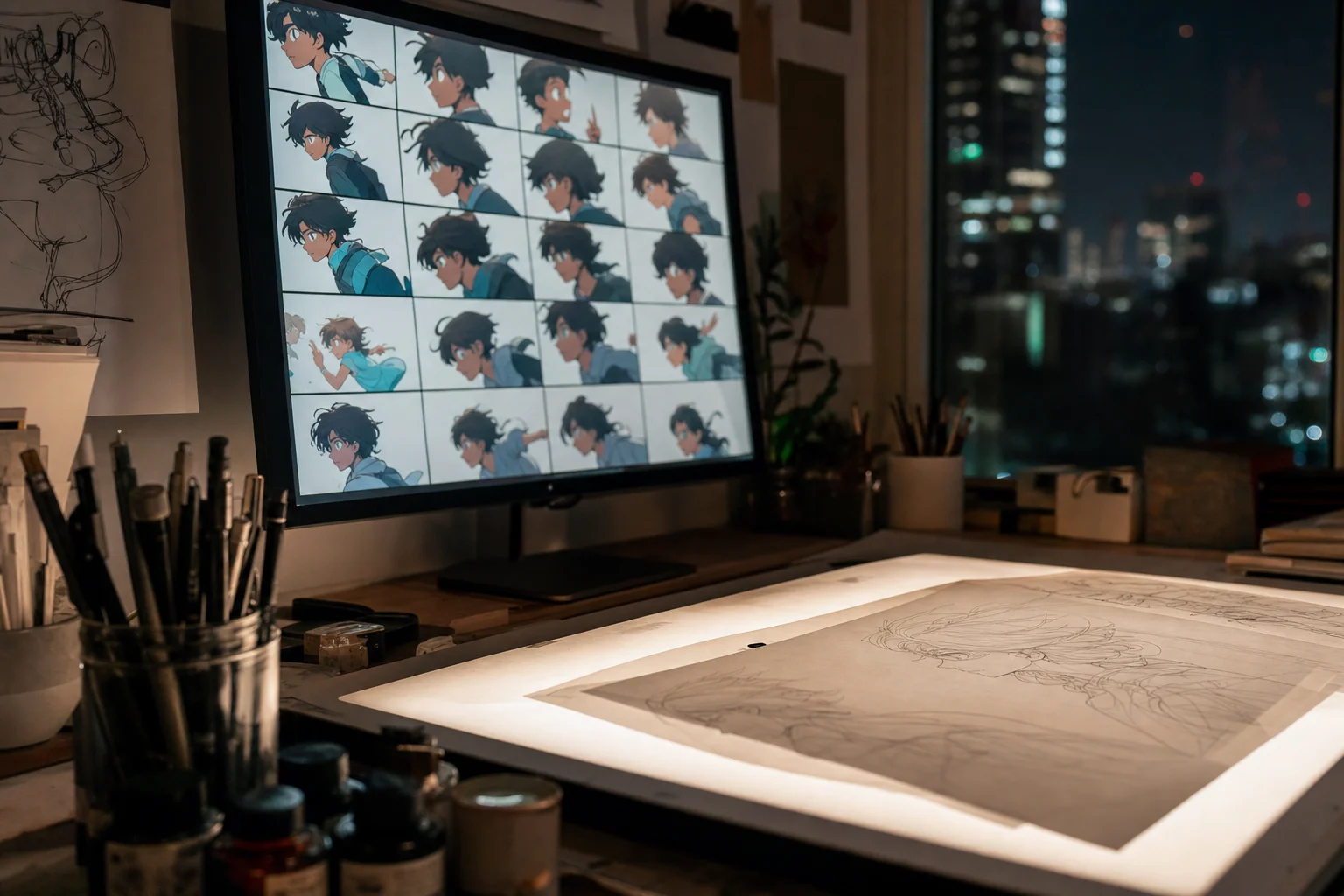
There is a particular kind of independent comics creator who has spent four years building an audience of thirty thousand readers and has never once been able to afford animation. Adapting even a single chapter has historically meant a studio, a budget, and a timeline measured in quarters.
That constraint has loosened in the past eighteen months, in a narrower way than the demo reels imply and a more useful way than the sceptics allow.
The problem is identity, not motion
Motion was the part everyone assumed would be hard. It turned out to be the easy part.
A manga page is already a storyboard — panels establish framing, beat order and emphasis, and the directorial work is done. Feeding a panel to a current video model produces convincing movement almost immediately.
What breaks is the character. Most video models generate each clip independently with no memory of the previous one, so the protagonist in panel three does not match the protagonist in panel one. The face structure shifts, the hair silhouette changes, a costume detail migrates across shots. In a mood piece nobody notices. In an adaptation, the character is the property, and a reader who has followed that character for four years notices immediately.
So the question that decides whether an adaptation works is not whether a tool can animate a panel. It is whether it can keep one specific character consistent across a whole sequence.
What changed architecturally
The tools that handle this stopped treating the character as a text description.
Instead of prompting for "a girl with a red scarf and a scar over her left eye" and hoping, they establish the character as a locked asset before any footage exists, then constrain every subsequent shot to reference it. Everything downstream — staging, shot order, scoring — operates against a fixed definition rather than re-deriving one each time.
Tools that turn manga into video with AI on this pattern run as a chain of specialised stages. OiiOii's version puts an IP Designer and Character Designer first to lock the design, then a Scene Designer and Storyboard Artist for staging and shot order, then a Sound Director. It routes 28 underlying generation models through that one pipeline, which for adaptation work matters more than it sounds: the entire job is matching an existing art style, and a platform with one house look will fight the source material on every shot.
The transferable principle is simpler than any product: a tool that lets you start generating before it has made you define your character will drift, and it will drift worst in exactly the long sequences where it matters.
What this does and does not enable
It does not produce a broadcast anime adaptation. Anyone claiming otherwise is selling something.
What it does enable, concretely: a three-to-five panel scene animated well enough to post. An opening sequence. A stylised trailer for a chapter launch. A pitch reel that shows a publisher or a platform what the property looks like in motion, which previously required spending the budget you were pitching for.
That last one is the genuinely interesting shift for the independent creator economy. The chicken-and-egg problem in comics adaptation has always been that demonstrating a property works in motion costs roughly what producing it costs. Decoupling those two things changes who gets to make the pitch.
A test worth running before committing a chapter
Any creator evaluating this can settle it in an afternoon:
- Take one character with a specific checkable detail — an asymmetric hairstyle, a scar, a distinctive collar.
- Generate four shots: a wide, a medium, a close-up, and a rear view turning to three-quarters.
- Lay the four stills side by side and inspect only face structure, silhouette and that detail. Ignore how attractive each frame is.
- Regenerate the weakest one twice. Does it converge toward the others, or wander further?
Convergence means the tool references a fixed character. Wandering means it re-rolls a description each time, and no amount of prompt engineering will fix that.
Then check two things specific to comics: whether the tool can hit your actual art style rather than a generic anime default, and whether it makes consistent colour choices if you are colourising from monochrome — an inconsistent palette drifts as visibly as an inconsistent face, and it is the failure mode people forget to test for.
The rights question creators keep getting wrong
Two distinct issues get collapsed into one worry, and separating them saves a lot of anxiety.
Your own property. If you drew the manga, you hold the rights to adapt it, and generating an animated version of your own characters does not change that. What varies is the tool's terms: check whether the platform claims any licence over generated output, whether commercial use is permitted on your plan tier, and whether outputs can be used in a work you intend to license onward. These answers differ meaningfully between platforms and they are in the terms rather than the marketing.
Everyone else's property. A tool that readily produces recognisable versions of existing anime characters is a liability signal, not a feature. It suggests the training or the guardrails are loose, and the same tendency will pull your original character toward established archetypes. For adaptation work you want a tool that builds specifically what you define — the ability to imitate someone else's IP is the same capability that erodes the distinctiveness of yours.
The third case worth naming: collaborative properties. If your comic had a co-writer, a colourist, or ran on a platform with a publishing agreement, adaptation rights may not be solely yours regardless of who drew it. That is a contract question rather than an AI question, but it surfaces at exactly the moment an adaptation starts looking feasible, and it is cheaper to check before you produce a trailer than after.
The realistic sequence
Start with one scene, not one chapter. Three to five panels, one character, enough to expose drift and small enough to discard.
Then an opening or title sequence — short, stylised, high tolerance for interpretation, and useful as promotional material regardless of what you decide next.
Then make a judgement about longer work based on what those two produced, rather than on what a demo promised.
Keep directing the shot order yourself. A manga's pacing is authorial: which beat gets three panels and which gets one is a decision the artist made, and no current tool infers it correctly from the page. The tools have moved the limiting factor from production capacity to direction, which for a creator who has been sitting on a finished property with no way to animate it is a considerably better problem to have.